What's changed is precision. Variable Data Printing (VDP) lets every piece in a single print run carry different text, images, offers, or QR codes — tailored to each recipient — without stopping the press. Small businesses, retailers, nonprofits, real estate agents, and local service providers all use it. The technology isn't new, but the accessibility is.
Many marketers still assume personalized print is expensive or complicated. The practical reality: modern VDP workflows have lowered the barrier considerably, especially for shorter, targeted runs where personalization does the heavy lifting that volume used to.
This guide covers how to actually run a VDP direct mail campaign — from data prep through post-campaign tracking — not just what VDP is in theory.
Key Takeaways
- VDP changes text, images, offers, and QR codes per recipient in a single print run
- Clean, segmented customer data is the single most important prerequisite
- 88% of marketers say personalization significantly improves direct mail response rates
- Production follows a set sequence: data prep, template design, file formatting, print, then response tracking
- Smaller, well-targeted VDP runs often deliver stronger ROI than large generic bulk mailings
When Does VDP Make Sense for Direct Mail?
VDP isn't reserved for enterprise campaigns. Even a 200-piece run benefits from personalization — if the data exists to support it.
The Right Conditions for VDP
VDP works when your audience has meaningful differences worth acting on: purchase history, geographic location, loyalty tier, last interaction date. The more those differences influence what someone would respond to, the more value personalization adds.
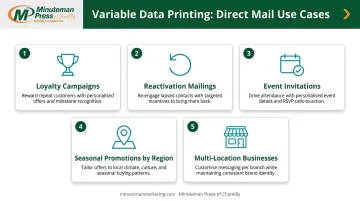
It performs well in these specific scenarios:
- Loyalty campaigns — rewarding repeat customers with tier-specific offers
- Reactivation mailings — win-back discounts for lapsed customers
- Event invitations — guest-specific details, personalized RSVP cards
- Seasonal promotions by region — different offers for different markets
- Multi-location businesses — location-specific contact details, maps, and hours on each piece from a single print run
When VDP Is the Wrong Choice
VDP gets misapplied more often than people admit. Two common mistakes:
- Cold lists with no behavioral data — if you don't know anything meaningful about recipients beyond their address, generic EDDM is often more cost-effective. Personalization requires something to personalize from.
- Over-personalizing with stale data — outdated or inaccurate records create embarrassing errors. A piece addressing someone by the wrong name, or referencing a product they never bought, does more damage than a generic mailer would.
Start by auditing your data before committing to VDP. Strong, current records unlock its full potential — weak records make a standard mailer the smarter spend.
What You Need Before Launching a VDP Campaign
Most VDP campaigns that miss their targets share a common thread: they skipped the groundwork. Get these three things in place before design or printing starts.
A Clean, Segmented Database
Your mailing list is the foundation. It needs:
- Verified names and mailing addresses
- CASS certification (confirms ZIP+4 accuracy; USPS requires a minimum 98.5% score for automation pricing eligibility)
- NCOALink processing (updates addresses against 160 million permanent change-of-address records)
- Clearly labeled columns for every variable field you plan to use
USPS PostalPro outlines CASS certification standards in detail. Mail sent without address verification risks being classified as Undeliverable-as-Addressed — waste that eats into campaign ROI before a single piece is read.
A Defined Set of Variable Elements
Decide what changes before you design anything. Common variable elements include:
- Recipient name and personalized greeting
- Offer tier or discount amount
- Product image based on purchase history
- Store location, hours, and contact details
- QR code linking to a unique landing page URL
The design template must accommodate these variables. Defining them after the layout is built typically means costly revisions that push your timeline back.
Print-Ready Files Structured for VDP
Most printers require two separate files:
- Base design file (typically PDF) — the layout without variable content filled in
- Variable data CSV — a spreadsheet where each row is a recipient and each column is a variable field
Column headers in the CSV must match the variable field names in the design exactly. One mismatch causes production errors across the entire run.
Our team at Minuteman Press of Chantilly handles direct mail services end-to-end — printing, mailing list processing, and USPS submission. Connecting with us during the file prep phase, before your job goes to press, is the most effective way to avoid the template mismatches and spec errors that delay production.
How to Execute a VDP Direct Mail Campaign Step-by-Step
Effective VDP campaigns follow a defined sequence. Skipping steps — particularly in data prep or file formatting — is the most common cause of production delays.
Setting Up Your Data and Segments
- Export and clean your list — remove duplicates, run CASS certification, and apply NCOALink processing
- Organize variable fields into clearly labeled CSV columns
- Assign segments — map which variable content applies to each recipient (for example, customers who purchased within the last 90 days get a loyalty offer; those lapsed 12+ months receive a win-back discount)
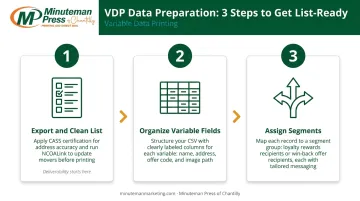
Decide segment logic before design begins — retrofitting it into a finished template wastes time and often forces layout compromises.
Designing Your Template for Variable Elements
Build the layout with reserved zones for variable content. Key considerations:
- Leave enough space to handle both short and long text strings (a first name like "Li" and one like "Christopher" need the same field zone)
- Check character limits for every variable field
- Use consistent fonts so variable swaps don't disrupt visual hierarchy
- Don't crowd variable elements — visual inconsistency across the run becomes a production problem
Preparing and Submitting Files
- Submit the base design PDF and variable data CSV as separate files
- Confirm the printer's exact file naming and format requirements
- Verify that CSV column headers match variable field names precisely
- Clarify QR code handling: does the printer generate QR codes from URL data in the CSV, or do you supply pre-rendered images?
Reviewing Proofs and Going to Press
Request a variable data proof showing at least 3–5 representative samples from different segments. Catching layout issues at the proof stage costs nothing; catching them mid-run can delay your entire mailing.
Before approving the proof, confirm:
- Layout holds across all segment variations (short and long text strings)
- Addressing method is settled: USPS submission handled by the printer, or bulk-shipped to you for self-mailing
Tracking Responses After Mailing
Build trackable response mechanisms into the design before going to press:
- Unique promo codes per segment
- Personalized URLs (PURLs) — unique landing pages per recipient or segment
- Dedicated phone numbers trackable by source
- QR codes linking to segment-specific pages
Set a response window — typically 2–6 weeks for direct mail — and record results by segment. This data tells you which variable combinations drove responses, and informs every subsequent campaign.
What Types of Businesses Benefit Most from VDP
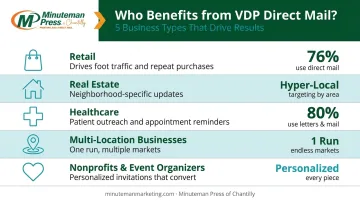
VDP direct mail fits naturally into several business types — some more than others. Here's where it tends to deliver the strongest results:
- Retail: USPS data shows 76% of retail marketers use direct mail for purchase-driven campaigns. VDP lets retailers segment by purchase history, send loyalty tier offers, and vary product imagery by customer preference.
- Real estate: Agents can send neighborhood-specific property updates, personalized market reports, and localized sold/listed announcements — all from a single template adjusted per recipient.
- Healthcare: Appointment reminders, patient-specific wellness information, and follow-up care instructions. Lob's 2025 data shows 80% of healthcare mailers use letters in envelopes, where personalized content carries significant weight.
- Multi-location businesses: One print run, multiple markets. Each piece carries the correct local address, phone number, hours, and imagery for its recipient's nearest location. No separate design files per branch.
- Nonprofits and event organizers: Personalized donor acknowledgment letters, invitations with guest-specific details, and pre-filled RSVP cards — recipients notice when a piece was written for them specifically, not a mailing list.
Best Practices to Maximize ROI with VDP Direct Mail
Prioritize Data Quality Over List Size
Lob's 2025 State of Direct Mail report found 48% of marketers struggle with outdated or incomplete customer data — which directly limits targeting effectiveness. A well-segmented list of 500 verified recipients will consistently outperform a generic mailing of 5,000 with poor data. Start with clean, verified data before worrying about volume.
Test Before Scaling
Run a small A/B test with two variable versions before committing to a full campaign run. Test one variable at a time to isolate what drove the response difference:
- Different offers (discount amount, free trial, bonus item)
- Different headline copy or calls to action
- Different images or location-specific references
The added print cost is minimal — and you get clear, actionable data before scaling.
Match Format to Message
| Format | Best For |
|---|---|
| Postcards | Short personalized offers, quick reads — ANA data shows postcards produce 92% ROI for house lists |
| Letter-sized envelopes | Prospect campaigns — ANA reports 112% ROI for prospect lists |
| Folded self-mailers | Tiered loyalty details, product recommendations |
| Brochures | Complex personalized content, multi-product campaigns |
Minuteman Press of Chantilly offers postcards in five sizes (4×6 through 6×11) and brochures in half-fold, tri-fold, z-fold, gate-fold, accordion-fold, and double-gate-fold — so the right format for your campaign is almost certainly available.
Avoid Over-Personalization
More variables don't mean better results. Focus on 2–3 high-impact elements per piece:
- Recipient's name
- A tailored offer tied to their purchase history or segment
- A relevant image or location detail
Adding too many variable fields creates visual inconsistency across the run and can make a piece feel intrusive rather than relevant.
Conclusion
Getting ROI from VDP direct mail comes down to discipline, not complexity. Clean data, flexible templates, and variable content matched to genuine audience differences — that's the repeatable formula. The technology makes it possible; preparation is what makes it work.
Treat VDP as an ongoing capability rather than a single campaign. Each mailing builds response data that sharpens the next. For businesses in Northern Virginia and the Washington DC area, Minuteman Press of Chantilly handles printing, variable data production, and USPS submission as a single-source solution — workflow support that removes friction between planning and production.
Frequently Asked Questions
What are examples of variable data printers?
Variable data printers are digital inkjet or laser-based presses capable of changing printed content between each piece. Common examples include production systems from HP Indigo, Xerox (FreeFlow and XMPie), and Canon (VarioPrint and ProStream). Unlike offset presses, these systems require no plate changes between variable pieces.
Which printing processes allow variable data printing?
Digital inkjet and laser (electrophotographic) printing support VDP because neither uses fixed plates — content can change between every piece. According to Xerox, digital printing is the standard method for modifying images and messages with VDP. Traditional offset lithography requires a new plate for any content change, making true one-to-one personalization impractical.
How much does variable data printing cost for direct mail?
Per-piece costs for VDP are typically higher than bulk offset printing. Key cost drivers include quantity, format size, paper stock, number of variable fields, and postage class. USPS Marketing Mail postage starts at $0.43 per piece for automated formats in 2025. Higher per-piece print costs are often offset by better response rates from targeted personalization.
What data do I need to start a VDP direct mail campaign?
At minimum: a mailing list with verified names and addresses, plus at least one additional field that drives meaningful personalization — purchase history, segment category, geographic location, or offer tier. Organize the data in a CSV file with clearly labeled columns that match your design template's variable field names.
How do I measure the ROI of a VDP direct mail campaign?
Before printing, embed a trackable response mechanism into each variable version: unique promo codes, personalized URLs, dedicated phone numbers, or QR codes all work well. After the response window closes (typically 2–6 weeks), compare revenue or conversions against total campaign cost — design, printing, postage, and data processing combined.
Can small businesses use variable data printing effectively?
Yes. VDP supports short, focused print runs — even a few hundred pieces — which suits small businesses well. The minimum for mailing services at Minuteman Press of Chantilly starts at 200 units. The advantage for small businesses is targeting a well-known local customer base with offers relevant to their specific history or location, eliminating the waste of mass generic mailings.