Introduction
Real estate farming requires one thing above all else: consistent visibility in a defined neighborhood. The agents who win listings in a target area aren't necessarily the most experienced — they're the ones homeowners see repeatedly, month after month, until their name becomes the one they associate with the neighborhood.
EDDM (Every Door Direct Mail) is how many agents achieve that saturation affordably. At $0.247 per piece in current USPS postage, it's cheaper than first-class mail at $0.78 per letter — and it requires no purchased mailing list.
What most real estate guides skip is the operational detail: what the design and printing process actually looks like, what USPS requires for compliance, and where agents go wrong before a mailer ever reaches a single doorstep — including the size and layout rules that get pieces rejected at the post office.
Key Takeaways
- EDDM delivers to every household on a selected carrier route — no address list required
- Mail pieces must meet USPS flat-size dimensions and include required postal markings
- Design and print quality directly affect how recipients perceive your professionalism
- Repeated mailings drive results — frequency matters more than any single campaign
- Full-service print providers handle compliance, bundling, and postal prep — freeing agents to focus on their farm
What EDDM Design and Printing Is — and Why It Matters for Real Estate Farming
EDDM is a USPS-certified program that lets you send oversized postcards or mailers to every household on a specific mail carrier route, without individual names or street addresses.
Real estate farming is the practice of consistently marketing to one geographic area — a specific neighborhood, subdivision, or ZIP code — until you become the agent people think of first when they're ready to sell. It's a long game built on repetition, not one-time campaigns.
EDDM fits this strategy because farming is about saturation — reaching everyone on the block, not screening for a specific type of homeowner. The goal is name recognition built through consistent presence, and that requires volume, not targeting.
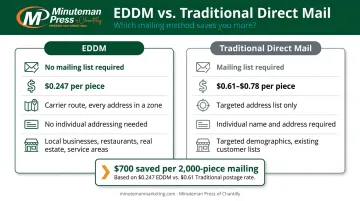
EDDM vs. Traditional Direct Mail
| Factor | EDDM | Traditional Direct Mail |
|---|---|---|
| Mailing list required | No | Yes |
| Postage per piece | $0.247 | $0.61–$0.78 |
| Delivery scope | Every household on a route | Targeted individuals only |
| Addressing | "Postal Customer" | Individual names |
| Best use case | Geographic farming | FSBOs, expired listings, past clients |
That postage difference adds up fast. On a 2,000-piece mailing, EDDM saves roughly $700 in postage alone compared to first-class letters — enough to cover printing costs for the following month's campaign.
Why Real Estate Agents Use EDDM for Geographic Farming
The University of Maryland's communications team references the marketing "Rule of 7" — the principle that a prospect should encounter your message at least seven times before taking action. In practice, real estate brand recognition in a neighborhood requires even more sustained contact than that.
EDDM's low postage rate is what makes that frequency achievable. If each mailing costs $0.78 per piece, sending to a 1,500-household neighborhood monthly becomes cost-prohibitive fast. At $0.247, it's manageable.
That cost gap also explains why agents who use targeted list mail for farming — rather than EDDM — often stall out. They spend more per piece, reach fewer homes, and end up cutting mailing frequency to control costs — which is exactly when a farm goes cold.
What Consistent EDDM Farming Actually Builds
- Homeowners start associating your face and name with the neighborhood
- Regular market updates establish you as the local expert
- Showing up every month signals stability — not a one-time push
- When a neighbor decides to list, your name is already the one they recognize
According to HousingWire, top-producing agents typically send 400–500 mailers monthly, with 125–150 dedicated to a defined geographic farm. The agents who get results are the ones who show up in mailboxes every month, not just around closing time.
How EDDM Design and Printing Works: Step-by-Step
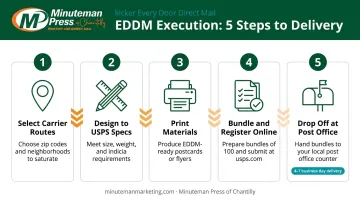
The EDDM workflow moves through five stages. Each one depends on the last, so a mistake early in the process compounds downstream.
Step 1: Select Your Carrier Routes
Start at the USPS EDDM Mapping Tool. You can select routes by ZIP code or draw a custom boundary, and filter by demographic data including median income, home values, household size, and resident age.
Route selection determines your print quantity. Every household on every selected route needs one piece, so get the count right before you go to print.
Step 2: Design Your Mail Piece to USPS Specifications
This is where compliance starts — and where most mistakes happen.
EDDM mailers must qualify as flat-size mailpieces under USPS standards. To qualify, your piece must exceed at least one of these minimum thresholds:
- 6⅛ inches high, or
- 11½ inches long, or
- ¼ inch thick
Maximum dimensions are 12 inches high, 15 inches long, and ¾ inch thick. Minimum thickness is 0.007 inches.
Your design must also include two required elements:
- Indicia: "PRSRT STD ECRWSS U.S. POSTAGE PAID EDDM RETAIL" — placed above and to the right of the address block, within 1.625 inches from the right edge and 1.375 inches from the top
- Addressing line: "Postal Customer" or "Local Postal Customer"
These are not optional. Missing or misplaced markings result in rejection at the post office.
For farming-focused content, effective designs typically include:
- A neighborhood-specific headline referencing a recent local sale or market condition
- A professional headshot and brokerage logo
- Current market data relevant to the target neighborhood
- A clear call-to-action
Minuteman Press of Chantilly offers custom design services and real estate postcard templates built to these specifications, including the 6×11 jumbo postcard format that works well for EDDM.
Step 3: Print Your Materials
Production requirements:
- Resolution: 300 DPI at final print dimensions (standard for commercial offset printing)
- Bleed: 0.125 inches beyond the trim line on all sides
- Safe zone: 0.125 inches inside the trim line (keep all critical content here)
- File format: PDF/X-1a or PDF/X-4 for print-ready files
- Stock weight: 14 pt or 16 pt card stock are the most common choices for EDDM postcards
The difference between professionally printed card stock and home-printed output is immediately noticeable. A heavier, glossy-finish piece signals credibility before a homeowner reads a single word — and in a competitive farm area, that first impression affects whether your CTA gets acted on or your piece goes straight to recycling.
Step 4: Bundle and Register Online
Before drop-off, pieces must be:
- Bundled in stacks of 50–100 per carrier route (no bundle taller than 6 inches)
- Facing slips printed from the USPS EDDM Online Tool and attached to the top of each bundle — one per route
- Postage paid online during registration through the EDDM tool
Full-service print providers can handle this step entirely, shipping pre-bundled, registration-ready mail directly to the serving post office. For agents without experience in postal preparation, this convenience is worth the cost.
Step 5: Drop Off at the Post Office
Deliver your bundled pieces with documentation to the post office serving your selected carrier routes. USPS staff verify compliance, then the mail enters the delivery cycle.
USPS Marketing Mail — the class EDDM uses — carries a general service standard of 4–7 business days for delivery within the contiguous 48 states. EDDM Retail doesn't publish a route-specific window, so plan your timing around that range.
Key Design and Print Specifications Realtors Must Know
Size Requirements (Summary)
| Specification | Minimum | Maximum |
|---|---|---|
| Height | Must exceed 6⅛" | 12" |
| Length | Must exceed 11½" | 15" |
| Thickness | 0.007" | ¾" |
| Weight | — | 3.3 oz |
Common sizes used by real estate agents: 6.5×9, 6.5×11, and 8.5×11.
Required Postal Markings
- Indicia text: "PRSRT STD ECRWSS U.S. POSTAGE PAID EDDM RETAIL"
- Placement: Upper-right area of address side, with 1/8" clear space on top and right edges
- Address line: "Postal Customer" or "Local Postal Customer"
Missing either element results in automatic rejection by USPS.
File Prep Essentials
- Resolution: 300 DPI at final size
- Bleed: 0.125" beyond trim on all sides
- Safe zone: Keep text and logos 0.125" inside trim
- Format: PDF/X-1a or PDF/X-4
Submitting files at 72 DPI (screen resolution) or without bleed are the two most common causes of printing delays or quality issues.
Paper Stock and Finish
- 14 pt card stock — standard quality, good for budget-conscious campaigns
- 16 pt card stock — thicker feel, conveys more premium quality
- Glossy UV finish — high visual impact, works well with property photography
- Matte finish — sophisticated look, easier to write on
- Spot UV — selective gloss accents on logos or headlines
Heavier stock with a glossy finish performs better for farming pieces because recipients are less likely to discard a mailer that feels substantial in their hands.
Quantity and Bundle Rules
- Minimum: 200 pieces per day per ZIP code
- Maximum: 5,000 pieces per day per ZIP code
- Bundle size: 50–100 pieces per stack, no taller than 6 inches
- Facing slips: One per carrier route, attached to the top bundle
Common EDDM Mistakes Real Estate Agents Make
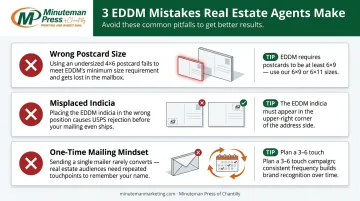
Most EDDM problems show up before a single piece hits a mailbox. Here are three mistakes that derail campaigns early:
- Using standard 4×6 postcard dimensions. A 4×6 postcard doesn't clear the EDDM flat-size minimum. The design gets built, sent to print, and then rejected or reprinted — wasting both time and budget.
- Misplacing the indicia. Putting the "ECRWSS EDDM" marking on the wrong side, or omitting "Postal Customer" from the address block, disqualifies the entire mailing. Generic design tools not built for EDDM compliance are a common cause.
- Treating EDDM as a one-time campaign. A single mailing builds almost no lasting recognition. Farming requires multiple exposures over months — that's what moves homeowners from "I've seen that name somewhere" to "let's call her."
When EDDM Is Not the Right Tool
EDDM works because it reaches everyone. That's also its limitation.
Skip EDDM when any of these apply:
- You need to reach specific individuals — expired listings, FSBOs, past clients, or investor buyers. Route saturation means mailing to hundreds of unrelated households to reach a handful of relevant ones. Addressed direct mail with a targeted list delivers better ROI here.
- Your route is too small — carrier routes under 150–200 households may not justify fixed design and production costs relative to other outreach methods.
- Route boundaries don't match your farm — gated communities or hyper-specific subdivisions often span multiple carrier routes or include households outside your target area. Check the USPS mapping tool before committing to a print run.
If you're only mailing EDDM reactively — once after a closing, once before a slow market — you're using a farming tool as an announcement tool. The value of EDDM is in consistent, repeated presence, not occasional deployment.
Conclusion
EDDM farming works when the process is done correctly: selecting the right carrier routes, designing to USPS flat-size and indicia specifications, printing on quality card stock, bundling properly, and mailing consistently over time. Miss any one of those steps and the campaign either stalls at the post office or fails to register with homeowners before a competitor does.
Getting the details right — specs, stock, schedule — is what separates agents who own a neighborhood in buyers' and sellers' minds from those who tried EDDM once and moved on. The campaigns that build real listing pipelines aren't the most creative ones. They're the ones that show up, meet standards, and keep coming back.
The practical checklist looks like this:
- Choose carrier routes that match your target price range and turnover rate
- Design to USPS flat-size dimensions with the indicia in the correct position
- Print on 100 lb. cover stock or heavier for durability and perceived quality
- Bundle in stacks of 50 with facing slips before dropping at the post office
- Commit to 6–12 months of consistent mailings before evaluating results
Frequently Asked Questions
How much does EDDM typically cost?
USPS postage runs $0.247 per piece for EDDM Retail (as of April 2026), compared to $0.61–$0.78 for first-class mail. When you add professional printing, total campaign costs typically land around $0.50–$0.75 per piece all-in, depending on quantity and card stock.
What are the two types of farming in real estate?
Geographic farming targets a specific neighborhood or ZIP code to build local brand recognition through consistent outreach. Demographic farming targets a buyer or seller profile — seniors, luxury buyers, or new movers — regardless of location. EDDM is purpose-built for geographic farming and isn't a practical fit for demographic targeting.
What size postcards are required for EDDM?
Your piece must exceed at least one of these minimums: 6⅛ inches high, 11½ inches long, or ¼ inch thick. Maximum is 12×15 inches. The most commonly used real estate EDDM sizes are 6.5×9 and 6.5×11.
What is the difference between EDDM and traditional direct mail for real estate?
EDDM delivers to every household on a carrier route with no mailing list required — postage runs $0.247 per piece. Traditional direct mail lets you target specific individuals by name, but you'll need to source address data, pay higher postage, and handle more setup work upfront.
How often should real estate agents send EDDM mailers for farming?
Monthly is the standard recommendation for active geographic farming, with bi-monthly as a minimum to maintain visibility. Consistency matters more than volume — homeowners who see your mailer every month remember you when they're ready to list.
Do I need a permit to send EDDM postcards for real estate marketing?
No. EDDM Retail requires no separate mailing permit. You register online through the USPS EDDM tool, pay postage during checkout, and drop off at the serving post office. If you use a full-service print provider, they may handle registration on your behalf.