Neither option is good. The Federal Reserve's 2025 Report on Employer Firms found that 56% of small businesses struggle to pay operating expenses, and 75% cite rising costs as a financial challenge. Locking working capital into bulk print orders they may never fully use only compounds that pressure.
No minimum order printing changes the equation. It's not just about ordering fewer items — it reshapes how small businesses manage cash flow, respond to market changes, and show up professionally in front of clients. This article breaks down the specific advantages, when they matter most, and how to apply them effectively.
Key Takeaways
- Order exactly what you need — no bulk commitments, no wasted inventory
- Protect working capital by paying for print materials only when you need them
- Test and update marketing materials without paying for obsolete stock
- Maintain professional print quality regardless of quantity ordered
- Single-unit ordering is available for business cards, flyers, postcards, brochures, and more — no minimums required
What Is No Minimum Order Printing?
No minimum order printing lets businesses order as few or as many copies as they need — without hitting a quantity threshold just to place an order.
Traditional print shops require minimums to offset setup and production costs. That's why you'll see 250 or 500 as the starting quantity for business cards at major retailers, or why USPS Every Door Direct Mail requires at least 200 mailpieces per campaign. Those minimums were designed around large-scale printing economics — not the realities of a 10-person business.
No minimum order printing changes that equation. Modern printing technology now makes small-run orders economically viable — so you're not forced to buy 500 copies when you only need 25.
Common products available through no minimum or low-minimum ordering:
- Business cards
- Flyers and postcards
- Brochures (multiple sizes and fold types)
- Letterhead and envelopes
- Posters and greeting cards
Minuteman Press of Chantilly offers this across all of these categories through its online platform, with a single-unit ordering model built for small businesses. Order exactly what you need — nothing more.
Key Advantages of No Minimum Order Printing for Small Businesses
These aren't theoretical conveniences. Each advantage connects to real metrics that affect whether a small business grows or stagnates.
Advantage 1: Cash Flow Protection and Reduced Financial Risk
The core issue with bulk print orders isn't the printing — it's the capital commitment. Ordering 1,000 brochures when you need 150 means paying for 850 units that may sit unused for months, or get discarded when prices or services change.
For small businesses already navigating tight margins, that's a real problem. The same Federal Reserve report cited above found 51% of small employer firms report uneven cash flow as an ongoing challenge. Every dollar sitting in a box of outdated flyers is a dollar that can't go toward payroll, inventory, or customer acquisition.
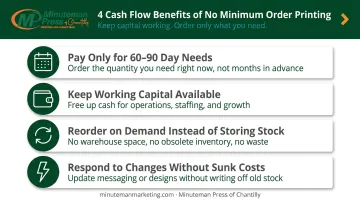
No minimum order printing changes how that capital flows:
- Pay for exactly what you'll use in the next 60-90 days
- Keep working capital available for revenue-generating activities
- Reorder when needed rather than storing excess stock
- Respond to pricing or messaging changes without absorbing sunk costs
When this matters most: Early-stage businesses still refining their brand, companies with seasonal demand, and any business where contact information, pricing, or service offerings change frequently.
Track these KPIs: Upfront print spend per quarter, inventory waste rate, and cash available for growth activities.
Advantage 2: Agility to Test, Update, and Personalize Print Materials
No minimum order printing lets small businesses treat print the way digital marketers treat ads — test a version, measure the response, adjust, and reorder. That's not possible when you're committed to 500 copies of one design.
In practice: a restaurant could order 30 postcards for a neighborhood promotion, see what drives foot traffic, refine the offer, and print a new version the following week. A consultant could bring 25 tailored brochures to a specific industry conference rather than distributing generic materials.
This matters because outdated materials don't just fail to generate leads — they actively damage credibility. BrightLocal research found 66% of consumers lose trust in a business if the phone number is wrong, and 60% if the address is incorrect. The same logic applies to print collateral with stale information.
Practical applications:
- Launch event-specific materials for trade shows or local events without a minimum run commitment
- Create audience-specific versions of brochures for different customer segments
- Update pricing, service offerings, or seasonal promotions without discarding old stock
- Test different calls to action across small print runs before scaling
When this matters most: Product launches, rebranding phases, event-driven marketing, and businesses targeting multiple audience segments.
Key metrics to watch: Campaign turnaround time, material obsolescence rate, and marketing cost per qualified lead.
Advantage 3: Professional Brand Presence Without Bulk Commitment
Modern digital printing produces the same color accuracy, resolution, and paper quality whether you order 30 postcards or 3,000. That removes a structural disadvantage small businesses used to carry. Before digital printing, producing premium materials in small runs was prohibitively expensive — which meant overpaying per unit or accepting lower-quality output.
Now, a business ordering 50 business cards through Minuteman Press of Chantilly gets the same 16PT cardstock, gloss or silk finish, and full-color printing as a company ordering 5,000. The physical impression is identical.
This has direct competitive implications. Direct mail to house lists generates a 15.6% response rate and 160.9% ROI according to the ANA's 2023 Response Rate Report — but only if the materials are current, accurate, and look professional. Small businesses can now compete on that level without a bulk budget.
What professional print quality enables:
- Walk into a sales meeting with fresh, accurate materials — not last year's brochure with crossed-out pricing
- Distribute materials at networking events without apologizing for outdated info
- Present the same caliber of collateral as much larger competitors
- Always have materials on hand rather than rationing the last few copies of a bulk run
When this matters most: Trade shows, client pitch meetings, local outreach campaigns, and any scenario where physical materials influence whether a prospect takes the next step.
KPIs this affects: Lead conversion rate at in-person events, brand consistency across touchpoints, and perceived professionalism in follow-up interactions.
What Happens When You're Locked Into Minimum Order Requirements
Minimum order requirements create a compounding problem. Small businesses are forced to choose between two bad outcomes: over-order and absorb waste costs, or under-order and run out of materials when they need them most.
Both outcomes damage operations in predictable ways:
- Outdated materials stay in circulation. A business that ordered 500 brochures won't reprint at 400 remaining, so prospects receive materials with old phone numbers, discontinued services, or last year's pricing. That erodes trust faster than having no materials at all.
- Capital gets locked in inventory. Money spent on 800 unused postcards can't respond to a new opportunity, a competitor's promotion, or a sudden seasonal shift.
- Print marketing gets deprioritized entirely. When the cost-benefit of bulk orders doesn't pencil out, many small businesses stop investing in print altogether — leaving a channel with proven ROI underutilized.
Minimum order requirements were designed around large-scale printing economics — and that model simply doesn't fit how small businesses operate. No minimum order printing addresses that directly, making print a practical, affordable channel for businesses working at smaller scales and shorter planning horizons.
How to Get the Most Value From No Minimum Order Printing
No minimum order printing works best as a regular practice, not a one-off solution.
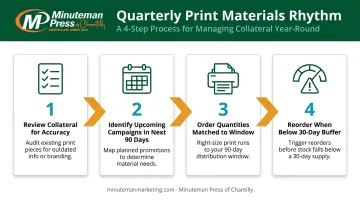
Build a quarterly rhythm:
- Review all print collateral for accuracy — contact info, pricing, services, offers
- Identify upcoming campaigns, events, or seasonal windows in the next 90 days
- Order quantities matched to that window (not a full year's supply)
- Reorder when stock drops below a 30-day buffer
Prioritize the materials that change most frequently — business cards when staff or contact info changes, event flyers before each campaign, promotional postcards for seasonal offers. Establish a baseline design that can be updated without a full redesign each time.
Minuteman Press of Chantilly makes this practical through its online platform. Key features include:
- Templates: Thousands of pre-loaded designs across 16 industry verticals, including Beauty & Spa, Food & Beverage, Events & Entertainment, and Real Estate
- Ordering paths: Select a template, design your own, or upload a ready file
- Turnaround options: Standard 2–3 business day production, next-day for $35, or same-day rush for $45 with 24/7 kiosk pickup in Chantilly
For businesses that want help, their in-house design team is available without the back-and-forth of traditional print shops. The goal is to remove friction from frequent small-batch orders so maintaining fresh, professional materials doesn't require significant time or resources.
Conclusion
No minimum order printing delivers compounding value across four interconnected areas:
- Protects cash flow by eliminating bulk commitments and inventory waste
- Enables agile marketing with materials that stay current and relevant
- Maintains a professional brand presence at any scale, at any event
- Reduces the hidden cost of outdated materials that never get used
Businesses that integrate no minimum order printing into a regular marketing cadence build a real edge in responsiveness and brand quality. Competitors locked into bulk print cycles simply can't pivot as fast.
Frequently Asked Questions
What does "no minimum purchase" mean?
No minimum purchase means you can order as few items as you need — even a single unit — without hitting a quantity threshold. Digital printing technology makes small runs cost-effective, eliminating the setup costs that forced traditional print shops to require minimums.
Is no minimum order printing more expensive per unit?
Per-unit cost may be slightly higher than bulk printing. But total spend is significantly lower since you only pay for what you actually use. The savings from eliminated waste and freed working capital typically offset the per-unit difference quickly.
What types of print products can small businesses order with no minimum?
Common products include business cards, flyers, postcards, brochures, posters, and greeting cards. Minuteman Press of Chantilly covers all of these in one place, with consistent quality across every product type.
How does no minimum order printing help with cash flow?
Small-batch ordering means you never lock working capital into print inventory you may not use. That keeps cash available for payroll, advertising, and other day-to-day priorities.
Can I still get professional quality with small quantity print orders?
Yes. Modern digital printing produces the same color accuracy, resolution, and paper quality regardless of order size. Small-batch orders from professional providers are indistinguishable in quality from large print runs.
How quickly can I receive a small print order?
Turnaround times vary by provider. Minuteman Press of Chantilly offers standard 2-3 business day production, next-day production for an additional $35, and same-day rush for $45. Local customers can also pick up orders anytime via the 24/7 kiosk.