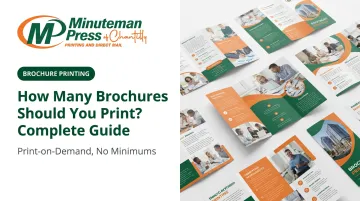
Brochure quantity is one of the most overlooked decisions in print marketing, yet it's easy to get right with the correct framework. The answer depends on your distribution channel, campaign duration, content shelf life, and how quickly your printer can turn around a reorder.
This guide walks through each factor, provides quantity benchmarks by use case, and explains how print volume affects your cost per unit.
Key Takeaways
- Quantity decisions start with your distribution channel — trade shows, direct mail, and retail displays each need different amounts
- Printing in larger quantities lowers your cost per brochure, but bulk-printing time-sensitive content creates waste
- The core formula: audience size × engagement rate + 10–15% buffer
- Order in increments that match your actual need — overstocking dated content is the most common (and costly) mistake
- A printer with no minimums and fast turnaround lets you start small and scale once your design is proven
Key Factors That Determine How Many Brochures to Print
There's no single universal number. The right quantity depends on several variables, and missing any one of them leads to either a costly overprint or an inconvenient shortage.
Distribution Channel and Audience Size
How you distribute brochures directly determines realistic uptake. Three channels behave very differently:
- Hand-to-hand at events — every brochure goes to someone who asked for it or was personally engaged; uptake is nearly 100% of interactions
- Rack or lobby display — passive pickup; visitors self-select, so only a fraction of foot traffic takes one
- Direct mail — quantity equals your list size, minus undeliverable addresses
Don't apply a single grab rate across all three. A tourism brochure rack at a hotel concierge desk performs nothing like a brochure stand in a dentist's waiting room.
Campaign Duration and Content Shelf Life
A brochure supporting a single weekend pop-up needs a different print run than one you'll distribute across multiple locations over three months. Longer campaigns also mean drop-off — brochures get buried under other materials, damaged, or simply lost.
Separate your content into two buckets before you order:
- Evergreen content (company overview, stable product catalog, service descriptions) — justifies larger runs; won't become obsolete
- Time-sensitive content (seasonal offers, event dates, specific pricing, staff names) — print in smaller, more frequent batches
According to a 2020 Staci Americas vendor report, roughly 25% of printed marketing materials are stored, discarded, or out of date before they're ever distributed. Bulk-printing volatile content is the main culprit.
Number of Versions and Reserve Buffer
If your business distributes different brochures for different products or audience segments, your total print budget must be split across versions — which reduces the per-version quantity for each brochure type.
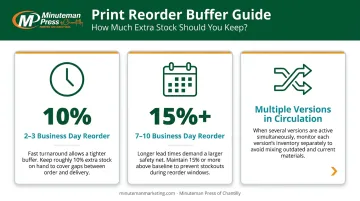
Whatever your estimated need, add a 10–15% buffer. The right buffer size depends on your printer's turnaround time:
- 2–3 business day reorder — a 10% buffer is adequate
- 7–10 business day reorder — carry 15% or more in reserve stock
- Multiple versions in circulation — track each separately; a stockout on one version can leave an entire segment unserved
How Many Brochures to Print by Use Case
Trade Shows and Conferences
Skip attendance-based guessing. The staff-capacity formula gives you a far more accurate number:
Brochures needed = show hours × booth staff × interactions per hour × handout rate + 15–20% buffer
Industry exhibit guidance cites 4–6 qualified interactions per staffer per hour as a realistic ceiling. Use 4 as your baseline for planning.
Example: An 18-hour show (3 days × 6 hours) with 2 booth staff at 4 interactions/hour = 144 planned conversations. If staff hands a brochure to every qualified visitor, print 165–175 copies per brochure version, plus extras for the media center or hospitality suite.
Typical ranges:
- Small regional show (1–2 days, 1–2 staff): 150–300 brochures
- Mid-size show (2–3 days, 3–4 staff): 400–800 brochures
- Large national show (3+ days, 5+ staff): 1,000+
EXHIBITOR's collateral guidance notes that most trade show literature ends up in the trash when left in open stacks. Train staff to hand brochures directly to qualified visitors — this cuts waste and improves actual engagement.
Direct Mail Campaigns
Here, the math is straightforward: quantity equals your deliverable list size. The main variable is address hygiene.
How you determine print quantity depends on your campaign type:
- Purchased or house list: Clean your list first — USPS OIG data shows undeliverable-as-addressed mail runs around 4.3% of total volume. Add a 3–5% overage for office records and follow-up copies.
- USPS Every Door Direct Mail (EDDM): The EDDM route tool shows exactly how many deliveries each carrier route covers — use that count directly as your print quantity.
Retail, Lobby, and Waiting Room Displays
Use a monthly replenishment model rather than a one-time estimate:
- Estimate monthly visitor or foot traffic for the location
- Apply a realistic grab rate (start conservatively at 5–15% for general retail or waiting rooms; tourism-specific racks can run much higher)
- Multiply by your replenishment frequency (monthly, bi-monthly)
- Add 10% buffer
Run those numbers and a waiting room seeing 200 patients per month at a 10% grab rate needs roughly 20 brochures per month per location. A quarterly replenishment order of 60–80 brochures covers that location comfortably.
Community Events, Pop-Ups, and Sponsorships
Rough benchmarks based on event size:
| Event Size | Attendees | Suggested Quantity |
|---|---|---|
| Small community event | Under 500 | 200–500 brochures |
| Mid-size event | 500–2,000 | 500–1,500 brochures |
| Large public event | 2,000+ | 1,500+ brochures |
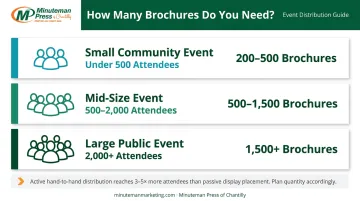
Adjust based on whether staff is actively distributing or brochures are sitting in a passive display. Active hand-to-hand distribution can move 3–4× more material than a tabletop stack — so if you're staffing a booth, lean toward the higher end of these ranges.
General Business Use (Ongoing)
Small businesses keeping a steady supply for sales meetings, welcome packets, and walk-in inquiries can use a simple quarterly formula:
- Estimate your monthly customer touchpoints (meetings, consultations, walk-ins)
- Multiply by 3 for a quarterly order
- Reorder on a consistent cycle to keep content current
A business with 40 monthly customer interactions should order roughly 130–150 brochures per quarter, adjusting up or down after the first cycle based on actual consumption.
How Print Quantity Affects Your Brochure Cost
The Cost Per Unit at Different Quantity Tiers
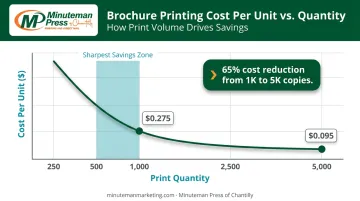
Commercial printing has two cost components: fixed setup costs (press prep, file processing, plate making) and variable costs (paper and ink). Setup costs don't change whether you print 250 or 5,000 copies — which is why the cost per brochure drops sharply as quantity increases.
A real-world example: an 8.5×11 tri-fold brochure on 100 lb. gloss book stock from a major online printer runs approximately $275 for 1,000 copies ($0.275 each) and $475 for 5,000 copies ($0.095 each) — a 65% reduction in cost per unit by going from 1,000 to 5,000 copies.
The biggest savings typically happen in the move from very low quantities (under 250) to moderate quantities (500–1,000). Beyond 2,500 units, the curve flattens and the per-unit savings become more incremental.
Why Round Numbers Matter
Commercial printers lay jobs on standard press sheets. Orders that don't fill a sheet cleanly either waste paper or require the printer to combine your job with others in ways that can slow production. Ordering at standard intervals — 250, 500, 1,000, 2,500, 5,000 — aligns with press sheet sizes and minimizes this friction.
Bumping an order from 475 to 500 can actually cost less in total because the printer isn't wasting partial sheets. If your quantity estimate lands at an odd number, round up to the nearest standard interval before you finalize the order.
Balancing Quantity with Content Freshness
Bulk pricing is compelling, but the math only works in your favor when the content won't change. For growing businesses or newly launched designs, a "print in waves" approach reduces risk:
- Start with a moderate run (250–500 copies) to test design effectiveness and gauge your actual consumption rate.
- Scale up on the second run once the design is proven and the content is confirmed stable.
- Settle into a rhythm of ordering quantities that cover roughly 2–3 months of distribution at a time.
Minuteman Press of Chantilly is built for exactly this kind of incremental approach. With no minimum order quantity on brochures, you can start with a single run to test the waters, measure actual consumption, and scale up only when the numbers justify it — without committing a large budget upfront.
Tips to Avoid Over-Printing or Running Short
Three practical habits keep your print quantities accurate over time:
Track consumption after every campaign. Record how many brochures were distributed versus how many were left over. After two or three cycles, you'll have a reliable baseline that removes the guesswork from future orders.
Drop unnecessary dates from evergreen brochures. Avoid printing specific event dates, seasonal language, or expiring offers on any brochure you plan to reuse. Undated brochures stay usable across multiple campaigns — no reprinting needed just because a date passed.
Use a printer with fast turnaround and easy reordering. A 2–3 business day reorder window lets you keep a smaller standing inventory and top up as needed. Minuteman Press of Chantilly offers standard production in 2–3 business days, with next-day (+$35) and same-day rush (+$45) options when timing is tight.
How Minuteman Press of Chantilly Can Help
Minuteman Press of Chantilly lets you order exactly as many brochures as you need — no bulk minimums, no wasted inventory. Whether you're printing 10 copies for a local event or several thousand for a regional campaign, you control the quantity.
Here's what's available:
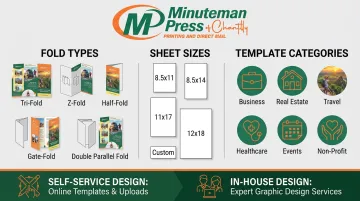
- Templates across 13 industry categories — Beauty & Spa, Food & Beverage, Events & Entertainment, Real Estate, and more — in 12 size-and-fold combinations
- In-house design team for custom work, plus a self-service design studio if you prefer to customize on your own
- Six fold types across three sheet sizes — 8.5×11, 8.5×14, and 11×17 — from half-fold to double-gate-fold
- Order any quantity — single units to bulk runs — with volume pricing available on request
- Standard production in 2–3 business days, with same-day or next-day options when timing is tight
- 24/7 pickup kiosk for local Chantilly-area customers who need their order fast
If you're still working out the right quantity, starting with a small test batch is a practical way to gauge actual pickup and response before committing to a larger run.
Frequently Asked Questions
How much does it cost to print 5,000 brochures?
For a standard 8.5×11 tri-fold on 100 lb. gloss book stock, publicly listed pricing from major online printers runs around $475 for 5,000 copies (roughly $0.095 per unit). Final cost varies based on paper stock, coating, fold type, and shipping, so always get a quote for your specific configuration.
How long does it take to print 1,000 brochures?
Most commercial printers turn around 1,000 brochures in 1–4 business days, with same-day or next-day rush options available at a premium. Minuteman Press of Chantilly offers standard 2–3 business day production, with next-day and same-day rush options available for a modest upcharge — check current pricing when ordering.
What are the most common brochure printing mistakes?
The three most frequent errors: printing large quantities of time-sensitive content that quickly becomes obsolete, selecting specialty paper or custom sizes that significantly inflate per-unit cost, and submitting design files without proper bleed or in the wrong color profile — which delays production or results in trimming errors.
Is it cheaper to print more brochures at once?
Yes: per-unit cost drops significantly as quantity increases because setup costs are fixed. The biggest savings occur moving from very low quantities (under 250) to moderate quantities (500–1,000). Order at standard intervals like 250, 500, or 1,000 to align with press sheet efficiency.
How many brochures should I bring to a trade show?
Use the formula: show hours × booth staff × 4 interactions/hour + 15–20% buffer. For an 18-hour show with 2 staff, that's roughly 165–175 brochures — add a small stack for media centers or hospitality areas.
Should I print brochures in-house or use a professional printer?
In-house printing works for very small runs (25–50 copies) where quality requirements are modest. For anything beyond that, professional printing delivers better cost per unit, consistent color, and proper stock options. Factor in paper, ink, labor, and equipment wear before concluding it saves money.