
Yard signs rarely get serious consideration in that conversation. They feel low-tech. But that perception overlooks what they actually do well: putting your name in front of the exact people most likely to hire you, repeatedly, at a cost that's difficult to match with any other medium.
This guide examines whether yard signs actually deliver business results, where they work best, what kills their effectiveness, and how to execute them correctly.
Key Takeaways
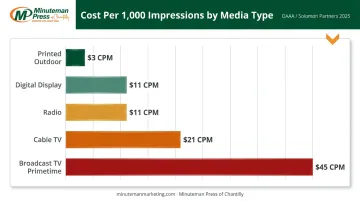
- Printed outdoor advertising benchmarks at $3 CPM — far cheaper than TV, radio, or digital display
- Physical OOH recall ranges from 43%–82%, outperforming online ads consistently
- Effectiveness depends on design clarity, legal placement, and consistent use over time
- Home services, real estate, retail, and events see the strongest results from yard sign campaigns
- Strategic placement of even a small sign run can drive measurable neighborhood-level reach
What Is Yard Sign Marketing?
Yard sign marketing uses custom-printed signs — typically made from 4mm corrugated plastic (commonly called Coroplast) — staked into the ground at visible outdoor locations to promote a business, service, or event.
Common sizes run from 18×24 inches for standard lawn signs up to 24×36 for larger placements. The use cases span a wide range of industries:
- Home services — marking active job sites, advertising service areas
- Real estate — for-sale listings, open house directionals, sold riders
- Retail — grand openings, seasonal promotions, sales announcements
- Events — directional signage, date and location announcements
- Contractors — neighborhood-level brand presence while work is underway
What makes yard signs effective is proximity. They put your message in front of people who already live and travel through your service area — the exact audience most likely to become customers.
Key Advantages of Yard Signs for Business
Hyperlocal Reach at a Fraction of the Cost
Cost efficiency is where yard signs make their clearest case. According to Solomon Partners' 2025 Major Media CPM Comparison published by OAAA, printed outdoor media benchmarks at $3 CPM — compared to broadcast TV primetime at $45 CPM, cable TV at $21 CPM, radio at $11 CPM, and digital display at $11 CPM.
For context: USPS Every Door Direct Mail postage alone runs $0.242–$0.247 per piece — roughly $242–$247 per 1,000 pieces before printing and design costs are added.
Yard signs aren't a named OAAA format with tracked impressions, so direct CPM comparison requires some judgment. Even so, the directional case is clear: a batch of signs, printed once, generates passive impressions 24 hours a day with no media buy, no recurring fees, and no ongoing campaign to manage.
Best fit for:
- Landscaping, HVAC, plumbing, pest control, and cleaning businesses with defined service zones
- Retail stores whose customers are concentrated in a few surrounding neighborhoods
- Any business that can't sustain continuous ad spend but needs consistent local presence
A one-time investment in yard signs keeps working until the signs are removed. Getting a comparable volume of local impressions through paid digital or print advertising means paying again every month.
Repeated Exposure Builds Recognition Without Additional Spend
A sign staked at a busy intersection reaches the same commuters every day. Unlike digital ads — which can be blocked, skipped, or ignored through banner blindness — physical signage accumulates impressions passively.
The evidence for this effect is meaningful. Nielsen's 2017 Poster Advertising Study found that average visually aided poster recall was 47%, rising to 55% at 11+ exposures. The same study found that 40% of viewers visited the advertised business and 24% made a purchase after noticing a poster. Among viewers who noticed directional posters, 55% changed their plans to visit the featured location.
These figures are for standard outdoor posters, not yard signs specifically. But the underlying mechanism — repeated physical exposure driving recognition and action — applies directly to signs placed on consistent commute routes.
The practical takeaway: a yard sign placed in the same high-traffic spot for several weeks isn't static advertising. It's compounding advertising. Each pass adds to the same viewer's cumulative brand exposure, which influences recall and trust over time.
Works well for:
- New businesses establishing awareness in a neighborhood
- Service businesses entering a new coverage area
- Any campaign where the goal is top-of-mind presence over a multi-week period
Versatility Across Industries, Campaigns, and Budgets
Yard signs adapt to nearly any local marketing objective. The same basic format works for a real estate listing, a roofing company's job site, a restaurant's grand opening, or a nonprofit's event — each requiring nothing more than a redesigned print.
The NAR's 2025 Home Buyers and Sellers Generational Trends Report found that 4% of buyers found the home they purchased through a yard sign or open house sign. That figure sounds modest, but at property level — where even one additional inquiry can change an outcome — it's a measurable channel worth maintaining.
For contractors and home service businesses, a sign at an active job site does something no digital ad can replicate: it shows neighbors that real work is happening nearby. Neighbors who watch a roof get replaced or a lawn get transformed are already pre-qualified prospects. A visible sign converts that curiosity into a contactable lead.
Practical flexibility advantages:
- Low cost per unit makes testing different messages or offers financially low-risk
- Signs are portable, reusable, and easy to rotate across locations
- A small initial run can be scaled up once placement effectiveness is confirmed
- No production delays or campaign manager required to update messaging
Compare that to a billboard, print ad, or radio spot — each locks in a message and a cost for the campaign duration. Yard signs can be reprinted for a new promotion within days.
What Happens When Yard Signs Are Done Poorly
Most yard sign failures trace back to design or placement errors — not to the medium itself.
Design Failures
The International Sign Association's guidelines recommend at least 1 inch of letter height for every 25 feet of viewing distance. A sign read from a moving car at 30 feet needs letters at least 1.2 inches tall — which rules out cramped layouts with small text.
Common design mistakes that reduce effectiveness:
- Too much text: a driver at 25 mph has roughly 2–3 seconds to absorb a message, so more than 5–7 words typically doesn't register
- Low-contrast color combinations: light on light or dark on dark both fail at distance
- No call-to-action: without a phone number, URL, or QR code, interested viewers have nowhere to go
- Illegible fonts: decorative or serif typefaces lose definition at small sizes
Placement Mistakes
Even a well-designed sign fails if it's placed where the wrong people see it, or where no one can read it in time.
- Signs facing fast-moving traffic without adequate viewing distance
- Obstructed sightlines from vegetation, parked vehicles, or competing signage
- Signs in areas that don't match the target customer's geography
- Placements in unauthorized locations — right-of-way restrictions vary by municipality, and cities like Phoenix have specific temporary sign rules in their zoning codes
Local ordinances govern size, setback, duration of display, and right-of-way placement. Ignoring these rules risks removal, fines, and lost investment.
The Cumulative Cost of Poor Execution
A failed yard sign reflects a specific execution — wrong placement, poor contrast, too much text. The fix is better design and smarter positioning, not writing off the format entirely.
How to Get the Most Value from Your Yard Signs
Design for Speed, Not Detail
The goal is for someone in a moving vehicle to read your core message in one glance. That means:
- One focused message — service name or offer, business name, and one call-to-action
- High-contrast colors — dark background with light text or vice versa
- Sans-serif fonts at generous sizes
- Enough blank space that the eye immediately finds the key information
Resist the urge to add a tagline, a list of services, and a full address. Every additional element competes with the one thing you need viewers to remember.
Place Signs Where Your Customers Already Are
Identify the three to five highest-traffic intersections or corridors within your service area, then pursue placement systematically:
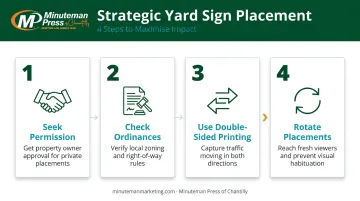
- Seek permission from property owners for private placements
- Check local ordinances before placing on public or right-of-way locations
- Consider double-sided printing — it captures traffic moving in either direction at an intersection
- Rotate placements periodically to reach fresh viewers and prevent visual habituation
For contractors, the job site itself is one of the best placements available — the neighbors watching the work are already interested.
Build Consistency, Not One-Off Campaigns
A single sign placed once produces limited results. A contractor who posts a sign at every active job site, month after month, builds sustained neighborhood name recognition that a one-time campaign never achieves.
Yard signs work best as part of a consistent, multi-touch print strategy. Pairing them with postcards, door hangers, or flyers reinforces your message across different touchpoints. Minuteman Press of Chantilly offers customizable templates and professional design assistance for businesses that want cohesive print marketing without starting from scratch.
Frequently Asked Questions
Do yard signs work for business?
Yes — yard signs are an effective local advertising tool, particularly for businesses targeting customers within a defined geographic area. Effectiveness depends on design clarity, legal placement, and consistent deployment rather than one-time use.
How much does a 4×8 sign cost?
Pricing varies by material, quantity, and printer. Corrugated plastic signs typically run $1–$5 per unit at volume, while heavier materials cost more. Bulk orders consistently reduce the per-unit cost regardless of format.
What are common yard sign mistakes?
The most frequent failures: too much text, low-contrast color choices, no clear call-to-action, and placement in unauthorized or low-traffic locations. Fonts that are hard to read at speed are also a consistent problem.
Where can I legally place business yard signs?
Regulations vary by municipality. Signs on private property generally require the owner's permission; public right-of-way placement is often restricted or prohibited. Check local zoning ordinances and any applicable HOA rules before ordering.
How long do yard signs last outdoors?
Corrugated plastic (Coroplast) is weather-resistant and waterproof by design. Lifespan depends on UV exposure, wind conditions, and handling. Most signs last 1–2 years under typical outdoor conditions; fade-resistant printing pushes that closer to the higher end.
How many yard signs do I need for a local business campaign?
A small run placed strategically across high-traffic locations can generate measurable visibility for a defined service area. Larger coverage areas or multi-neighborhood campaigns benefit from higher quantities. Most local campaigns start with 25–50 signs and scale up based on results.