It matters because the wrong format wastes money. A folded mailer sent to a cold audience at twice the postage cost may see lower redemption than a simple postcard. A postcard crammed with five different offers loses the clarity that makes postcards work. Format isn't just aesthetics — it's strategy.
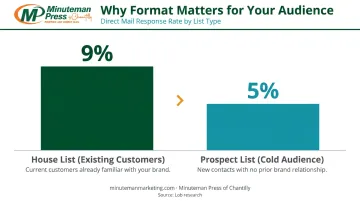
The good news: direct mail coupons still perform. According to Lob's research, direct mail averages a 9% response rate for house lists and 5% for prospect lists — far ahead of most digital channels. Physical mail with a clear offer gives businesses a real edge when the format matches the campaign.
This guide breaks down both formats — what they are, what they cost, and which one fits which campaign type.
Key Takeaways
- Postcard coupons work best for single offers, cold audiences, and tight budgets
- Folded mailers work best for multiple offers, existing customers, and premium brand positioning
- USPS postcard postage ($0.61) beats letter-rate ($0.78), provided your piece fits within the 4.25" x 6" size limit
- EDDM at $0.247 per piece makes postcard coupons the most affordable option for neighborhood saturation
- Both formats deliver strong results when the offer, design, and audience targeting are aligned
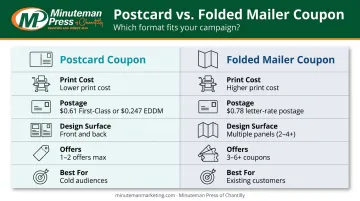
Postcard Coupons vs Folded Mailer Coupons: At a Glance
Both formats are self-mailers — no envelope needed — but they differ significantly in cost structure, design space, and campaign fit.
| Dimension | Postcard Coupon | Folded Mailer Coupon |
|---|---|---|
| Printing cost per piece | Lower | Higher |
| Postage rate | $0.61 (First-Class) or $0.247 (EDDM) | $0.78 (letter rate) |
| Design surface | Front + back only | Multiple panels (2–4+) |
| Coupons that fit | 1–2 maximum | 3–6+ with room for detail |
| Ideal campaign type | Single offer, cold audience, EDDM | Multi-offer, existing customers, loyalty |
The Postage Rate Difference
This is where format choice becomes a budget decision. A standard postcard (up to 4.25" x 6") qualifies for USPS First-Class postcard postage at $0.61 per piece. Exceed that size — say, a 5.5" x 8.5" or 6" x 9" postcard — and USPS reclassifies it as a letter at $0.78 per piece.
Folded mailers almost always mail at the letter rate. On a 2,000-piece run, that $0.17 difference adds up to $340 in postage alone. For EDDM campaigns, the gap widens further — EDDM Retail runs at just $0.247 per piece, making neighborhood saturation with postcard-format pieces significantly more affordable.
What Are Postcard Coupons?
A postcard coupon is a single-ply printed piece that carries a discount offer, promotional code, or redeemable incentive directly on its face. No envelope. No unfolding. The offer is visible the moment it lands in the mailbox.
Common sizes at Minuteman Press of Chantilly:
- 4" x 6" (qualifies for First-Class postcard rate)
- 5" x 7"
- 5.5" x 8.5"
- 6" x 9"
- 6" x 11" (jumbo)
Only the 4" x 6" size reliably qualifies for standard postcard postage. Larger sizes mail at the letter rate, so the postage savings disappear — though you gain more design space in return.
The no-envelope format is a genuine advantage for coupon delivery. USPS notes that postcards arrive with "the message — no envelope to open," which means the offer gets seen before anything else. Recipients don't have to decide whether to open it. That removes one friction point between your offer and your customer.
Design Constraints Worth Knowing
Postcard coupons work best when the offer is singular and immediately clear. The limited surface area forces discipline: one compelling offer, a clear expiration date, and a strong call to action. That's not a weakness — for the right campaign, it's exactly what drives redemption.
Offers that translate well to postcard format:
- Percentage off (20% off your next visit)
- BOGO deals
- Free item or service with purchase
- Fixed-dollar discounts ($10 off orders over $50)
If your offer needs paragraphs of explanation or terms, a postcard isn't the right vehicle.
Use Cases for Postcard Coupons
Local service businesses get the most mileage from postcard coupons — particularly where a single strong offer can move foot traffic quickly. Natural fits include:
- Restaurants and food & beverage businesses
- Nail salons and beauty & spa studios
- Auto service shops and dry cleaners
- Retail stores running seasonal promotions
EDDM is where postcard coupons really shine. USPS EDDM Retail costs $0.247 per piece and requires no mailing list — you select postal carrier routes and saturate an entire neighborhood. Minimum order is 200 pieces, maximum is 5,000 per ZIP code per day. EDDM postcard campaigns are ideal for grand openings, new customer acquisition, and neighborhood-level promotions where you want maximum reach at minimum cost.
Minuteman Press of Chantilly carries EDDM-compliant postcard templates across food & beverage, beauty & spa, and retail verticals — ready to customize and print without starting from scratch.
What Are Folded Mailer Coupons?
A folded mailer coupon is a single sheet folded into multiple panels — bifold (2 panels), trifold (3 panels), Z-fold, accordion fold (4 panels), or gate fold — sealed with glue or wafer tabs and mailed without an envelope. The extra panels create significantly more printable surface than any postcard can offer.
USPS classifies these as folded self-mailers. To mail at the letter rate, they must stay within automation-letter dimensions: 5" to 10.5" long, 3.5" to 6" high, maximum 3 oz in weight. Pieces using 70 lb. paper (or heavier) qualify; lighter stock may not hold up to USPS automation equipment.
What the Extra Space Enables
More panels means more room to work with. For coupon campaigns specifically, that translates to:
- Multiple coupons — sometimes with perforated tear-outs for easy redemption
- Service descriptions and loyalty program details, helpful when your offerings need brief context
- Seasonal promotion calendars — when you need to communicate upcoming events alongside current offers
The format also carries a different visual weight in the mailbox. A folded mailer looks more substantial than a postcard — closer to a mini-catalog or booklet. That perceived value matters for businesses at a premium tier or reinforcing trust with existing clients.
Minuteman Press of Chantilly offers brochures in six fold configurations (Half-Fold, Tri-Fold, Z-Fold, Gate-Fold, Accordion-Fold, and Double-Gate-Fold) across three sheet sizes (8.5x11, 8.5x14, and 11x17), with paper options from standard text weight up to 130# gloss or silk cover stocks. With no minimum order requirement, they're accessible for small test runs before committing to a full campaign send.
Use Cases for Folded Mailer Coupons
The businesses that get the most from folded mailers tend to have either a diverse service offering or an existing customer relationship worth nurturing:
- Grocery stores and multi-location retailers running weekly or seasonal multi-item promotions
- Spas and wellness centers juggling multiple service categories — massage, facial, nails, body treatments
- Home services companies offering seasonal packages across several service types
- Subscription businesses rewarding existing subscribers with tiered member pricing
Folded mailers are particularly well-suited to loyalty campaigns. When you're mailing to a house list — customers who already know your brand — the additional content space justifies the higher per-piece cost. Existing customers are more likely to read the full piece and redeem multiple coupons. Lob's data shows house list response rates average 9%, compared to 5% for cold prospect lists, which supports putting a richer format in front of people who already trust you.
Which Format Should You Choose?
Run through these four factors before committing to either format.
1. Budget
Postcard coupons cost less to print and mail. If you're working with a tight per-piece budget or mailing in high volume to a cold audience, postcards win on economics — especially via EDDM at $0.247 per piece. Folded mailers cost more upfront, but if the offer value and audience engagement are high, the return can justify the premium.
2. Number of Offers
One strong offer? Postcard. Three or more offers? Folded mailer. Trying to fit multiple deals onto a postcard dilutes each one and creates visual clutter that hurts redemption.
3. Audience Familiarity
- Cold prospect list → postcard. New audiences don't need depth — they need a clear, fast reason to act.
- Existing customer list → folded mailer. Loyal customers will engage with more content, and the richer format signals that they're receiving something of value.
4. Campaign Complexity
Simple, time-sensitive flash sale? Postcard. Multi-product seasonal campaign with several moving parts? Folded mailer.
Situational Recommendations
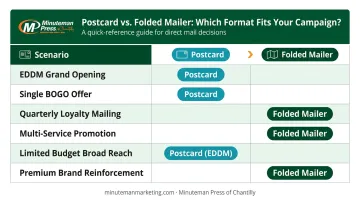
| Scenario | Best Format |
|---|---|
| EDDM grand opening to new neighborhood | Postcard |
| Single BOGO offer with hard expiration date | Postcard |
| Quarterly loyalty mailing to existing clients | Folded mailer |
| Multi-service promotion (3+ offers) | Folded mailer |
| Limited budget, broad geographic reach | Postcard (EDDM) |
| Premium brand reinforcement with existing customers | Folded mailer |
A Real-World Illustration
Consider two businesses facing this decision:
A local pizza restaurant is opening a second location. They want to reach every household within a 3-mile radius — a cold audience with no prior relationship with the new location. Their offer: a single BOGO pizza deal valid for the first two weeks.
A 6" x 9" postcard via EDDM hits their distribution goal at the lowest possible per-piece cost, and the single offer is impossible to miss. No explanation needed. Act now.
A multi-service day spa is sending its quarterly mailing to 1,500 existing clients. They're promoting four services at different price points — massage, facial, nail services, and a new seasonal treatment — plus early-access pricing for loyalty members.
A trifold mailer gives them a panel for each offer, room for loyalty program details, and a format that feels like it was worth receiving. The higher per-piece cost is justified by the audience quality: these are proven buyers.
When in doubt, match the format to the relationship stage and the number of offers — those two factors matter more than budget alone.
Minuteman Press of Chantilly offers customizable templates for both postcards and folded mailers, along with professional design support — whether you're customizing a pre-built template or uploading your own artwork.
Conclusion
After weighing both formats, the takeaway is straightforward: postcard coupons and folded mailer coupons serve different moments in the customer relationship. A well-run direct mail strategy may use both throughout the year. Postcards work for acquisition and seasonal blitzes; folded mailers suit loyalty campaigns and multi-offer promotions.
The format that drives the best results is the one that matches your offer structure, your audience, and your campaign goal — not simply the cheaper option. Start there, and the right choice becomes clear.
Frequently Asked Questions
How much does postcard marketing cost?
Printing typically runs $0.32 to $0.45 per piece for standard runs, with a 500-piece full-color campaign costing roughly $294 according to USPS estimates. Postage adds $0.61 per piece (First-Class) or as low as $0.247 per piece via EDDM, depending on your distribution method and piece size.
Is email marketing less expensive than direct mail marketing?
Email costs $0.01 to $0.05 per send versus $0.50 to $3.00 for direct mail. However, Lob reports direct mail response rates of 4%–5% compared to 0.5%–1% for email — meaning the cost-per-response gap closes considerably when you factor in actual engagement.
Does postcard marketing still work?
Yes. Postcards work because the offer is visible immediately — no envelope to open, no decision to engage. Lob's 2025 research found that 84% of recipients read direct mail the same day it arrives, making postcards one of the most reliable direct mail formats.
What types of businesses benefit most from postcard coupons?
Local service businesses with a single strong offer and a geographic target area see the best results — restaurants, nail salons, auto service shops, retail stores, and any business using EDDM to reach new customers in a defined neighborhood.
Can I include multiple coupons in a folded mailer?
Yes. Folded mailers offer enough panel space to include multiple distinct offers, and some designs incorporate perforated tear-out coupons for easy customer redemption. This makes them well-suited for businesses with several services or product categories to promote simultaneously.
Which direct mail coupon format has better response rates?
It depends on the audience. Postcard coupons tend to perform well for broad acquisition campaigns targeting cold audiences. Folded mailers often see stronger redemption from existing customers, where higher perceived value and multiple offer options better match what they already expect from your brand.