Introduction
Most local businesses don't need a massive list to run effective direct mail — they need the right streets. Two methods make that possible without building a list from scratch: Every Door Direct Mail (EDDM) and Saturation Mail.
Both methods blanket geographic areas without requiring a traditional mailing list. They differ, though, in how they're processed, how efficiently they scale, and how much targeting control you actually get.
That distinction matters more than most businesses realize. According to the USPS EDDM Fulfillment Kit, 66% of consumers surveyed engaged with or acted on direct mail they received — so the channel works. Choosing the right method determines whether your budget reaches the right doors.
This guide breaks down how each method works, where each performs best, and how to pick the one that fits your campaign and budget.
Key Takeaways
- EDDM is a USPS self-service program requiring no permit, no mailing list, and no bulk mail account — ideal for low-volume neighborhood campaigns.
- Saturation Mail runs through a commercial bulk mail system, making it more cost-efficient at high volume.
- Both methods skip individual address targeting and focus on geographic coverage.
- EDDM is the simpler option; Saturation Mail offers greater scalability and address-type filtering.
- Your best fit depends on volume, frequency, and whether filtering certain address types matters.
EDDM vs. Saturation Mail: Quick Comparison
| Factor | EDDM (Retail) | Saturation Mail |
|---|---|---|
| Postage Rate | $0.247/piece (flat, up to 3.3 oz) | $0.241–$0.290/piece (flat, depending on entry point) |
| Mailing List | None required | None required; address file compiled by mail house |
| Permit Required | No | Yes (bulk mail permit) |
| Processing | Manual bundling by customer, dropped at local post office | Automated via bulk mail house |
| Address Filtering | None — entire carrier route | Residential-only filtering possible |
| Volume Cap | 5,000 pieces/day per ZIP code | No Retail-style daily cap |
| Best For | Low-volume, starter, neighborhood campaigns | High-volume, recurring, or multi-ZIP campaigns |
Postage rates per USPS Notice 123, effective April 26, 2026
What Is EDDM?
Every Door Direct Mail (EDDM) is a USPS program that lets any business send printed mail pieces to every address on one or more carrier routes — no mailing list, no individual addresses, and no bulk mail permit required. Because pieces go out unaddressed (labeled "Local Postal Customer"), USPS offers a discounted postage rate of $0.247 per piece for Retail flats as of April 2026.
How EDDM Works Operationally
EDDM isn't complicated, but it does require hands-on prep work:
- Design a qualifying mail piece — EDDM uses USPS Marketing Mail flat sizes. Your piece must exceed at least one flat-size threshold: longer than 10.5", taller than 6.125", or thicker than 0.25". Maximum dimensions are 15" x 12" x 0.75". Standard 4x6 postcards don't qualify.
- Print your pieces — Production quantity determines how many carrier routes you'll cover.
- Bundle by carrier route — Stacks of 50–100 pieces with USPS-required facing slips for each bundle.
- Drop off at your local post office — USPS handles final delivery to each address on the selected routes.
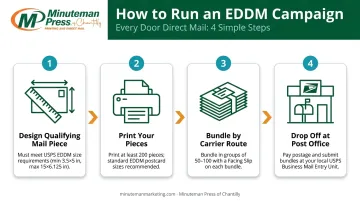
USPS caps EDDM Retail at 5,000 pieces per day per ZIP code and requires a minimum of 200 pieces per mailing.
Who EDDM Is Built For
EDDM is a saturation tool, not a targeting tool. It works best when your ideal customer is simply "someone who lives nearby." USPS identifies these as the clearest fits:
- Restaurants — grand opening announcements, menu drops, coupon offers
- Real estate agents — neighborhood farming, listing announcements
- Home services — HVAC, landscaping, pest control — building route-level name recognition
- Healthcare providers — dentists and chiropractors introducing a new location
- Retail and gyms — grand openings, seasonal promotions
The USPS EDDM online tool provides average household income, median age, and average household size by carrier route — useful for basic route filtering without individual-level targeting.
The Hidden Logistics Challenge
For campaigns covering one or two routes (a few hundred to a couple thousand pieces), EDDM's manual prep is manageable. For larger campaigns spanning multiple ZIP codes, the bundling, labeling, and multi-location drop-off process becomes labor-intensive. That labor cost is invisible in the postage rate but very real in practice.
Businesses in Northern Virginia and Chantilly can sidestep the production burden by working with a local print partner like Minuteman Press of Chantilly, which handles EDDM postcard design and printing — keeping campaign prep off the business owner's plate.
What Is Saturation Mail?
Saturation Mail is a commercial USPS Marketing Mail category (Enhanced Carrier Route, or ECR) that achieves the same geographic blanket coverage as EDDM, but runs through an automated bulk mail system rather than EDDM's self-service Retail process.
How It Differs From EDDM
The core operational difference: saturation mailing is processed by a mail house, not manually prepared by the business. A mail house handles sorting, walk-sequence marking (ECRWSS), bundling, and bulk entry at a USPS Business Mail Entry Unit (BMEU). That automation eliminates the manual labor that makes EDDM cumbersome at scale.
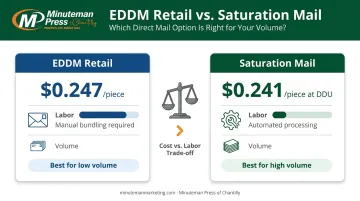
Postage rates for commercial saturation flats run $0.290/piece at non-presort entry down to $0.241/piece at DDU entry — comparable to EDDM Retail at $0.247, but with lower labor overhead at high volumes.
The Key Advantage: Residential Filtering
USPS Marketing Mail saturation rules support residential-focused delivery, meaning saturation campaigns can be structured to reach residential addresses rather than every delivery point on a route. For businesses whose offer is relevant only to homeowners — pool maintenance, high-end landscaping, home security — this reduces wasted spend compared to EDDM's all-or-nothing carrier route coverage.
Where Saturation Mail Fits Best
- Businesses running monthly or seasonal mailing schedules
- Campaigns covering multiple ZIP codes or large geographic areas
- Companies where mailing to every commercial address on a route represents wasted spend
- Organizations that have outgrown EDDM's manual logistics
Saturation mail isn't a DIY process. It requires a bulk mail permit and works through a mail house or professional printing partner with bulk mail capabilities. For businesses with consistent mailing volume, the permit investment pays off quickly through lower per-piece costs and eliminated prep labor.
EDDM vs. Saturation Mail: Which Strategy Works Best?
The right method depends on your volume, frequency, and operational situation — not abstract superiority.
The Decision Framework
Choose EDDM when:
- Your campaign is a one-time or introductory neighborhood mailing
- Volume is under a few thousand pieces
- You want a no-permit, low-barrier entry into direct mail
- You're covering one or two postal routes
Choose Saturation Mail when:
- You're mailing 10,000+ pieces or covering multiple ZIP codes
- Recurring monthly or seasonal mailings are planned
- Excluding residential-only vs. all deliveries matters to your offer
- You're working with a mail house as part of your workflow
Cost Reality Check
At postage only, the difference between the two methods is small:
| Volume | EDDM Retail ($0.247) | Saturation Flat at DDU ($0.241) | Difference |
|---|---|---|---|
| 1,000 pieces | $247 | $241 | $6 |
| 10,000 pieces | $2,470 | $2,410 | $60 |
The real cost gap isn't postage — it's preparation. At 10,000 pieces, manual EDDM bundling adds up to significant labor time. Saturation mail's automated processing absorbs that cost, often making it the more economical option at high volume even accounting for permit fees and mail house charges.
Real-World Scenarios
Scenario 1 — EDDM is the right call: A new restaurant opening in Chantilly runs a 2,500-piece EDDM campaign targeting two carrier routes in the surrounding neighborhood. No mailing list required, campaign launches quickly, and every nearby household gets a grand opening coupon. Low volume, time-sensitive, and geographically tight — exactly what EDDM handles well.
Scenario 2 — Saturation Mail is the right call: An established HVAC company in Northern Virginia runs monthly postcards to 15,000 residential addresses across six ZIP codes, structured to reach residential deliveries where homeowners control their own systems. Automated bulk processing makes this volume practical, and the residential-focused delivery reduces wasted spend. At this scale and frequency, EDDM's manual logistics can't keep up.
If you're just starting with local mail marketing, EDDM is the natural entry point. As campaigns grow in volume, frequency, or geographic reach, saturation mail becomes the more efficient system. That progression is expected — and it means the strategy is gaining traction.
Conclusion
The right choice between EDDM and saturation mail depends on how much control you need and how far you want to reach. EDDM lowers the barrier to entry for neighborhood outreach; saturation mail scales that reach more efficiently. Either way, the delivery method is secondary to what you put in the mailbox.
For local businesses in Northern Virginia and Chantilly, direct mail remains one of the most practical ways to build neighborhood-level brand recognition. Print quality, offer clarity, and how often you show up in mailboxes will drive results far more than which program you choose.
Getting those details right starts with working with a printer that understands the full process. Minuteman Press of Chantilly handles postcard printing and EDDM services in-house — design, production, and USPS submission — so your campaign is ready to mail without the back-and-forth.
Frequently Asked Questions
What is Every Door Direct Mail (EDDM) and how does it work for neighborhood marketing?
EDDM is a USPS program that lets businesses send mail to every address on a selected carrier route — no mailing list or bulk mail permit needed — at discounted flat-rate postage. It's a straightforward entry point for neighborhood-level saturation, with USPS handling final delivery once you drop bundles at the local post office.
How much does EDDM typically cost for a local saturation campaign?
EDDM Retail postage runs $0.247 per piece as of April 2026. Total campaign cost depends on print quantity, postcard size, and number of routes — but postage alone on 2,500 pieces runs about $617, making it one of the more affordable ways to reach a local neighborhood at scale.
Is EDDM worth it for neighborhood marketing?
Yes, for businesses whose customers are defined by proximity rather than specific demographics — restaurants, home services, dental practices — EDDM delivers strong visibility without the cost of a purchased mailing list. Consistent repeat campaigns tend to outperform one-time drops.
What are common mistakes to avoid when using EDDM?
The most common pitfalls are selecting routes by gut feel instead of USPS demographic data, using a weak offer that doesn't motivate action, and running a single campaign instead of building frequency. Don't underestimate the manual bundling and post office drop-off required at higher volumes.
Can saturation mail exclude certain address types like apartments?
USPS Marketing Mail saturation rules support residential-focused delivery, which allows campaigns to target residential addresses rather than every delivery point on a route. This is a real advantage for offers relevant only to homeowners, unlike EDDM which covers every address on a selected carrier route.
When should a business switch from EDDM to saturation mail?
Switch when campaigns reach 10,000+ pieces, when you're mailing on a recurring monthly or seasonal schedule, or when residential-only targeting would cut significant wasted spend. Automated bulk mail processing becomes more cost-effective than EDDM's manual prep at that volume.