For agents, the stakes are equally high on the listing side. A polished, professionally printed brochure signals investment and competence before you've said a word. In a competitive farm area or a crowded listing presentation, that first impression matters.
This guide covers the four brochure types every agent needs, what to include in each, design principles that convert browsers into buyers, and how to print and distribute pieces that actually get kept.
Key Takeaways
- Real estate brochures build credibility, support listings, and keep agents top of mind between meetings
- Four brochure types cover every stage: property brochures, agent bio pieces, client guides, and market updates
- Strong brochures lead with professional photography, benefit-driven copy, and a clear call to action
- Paper weight and finish directly affect how buyers and sellers perceive your brand
Why Real Estate Brochures Still Work
The assumption that print is obsolete gets repeated often, but the evidence doesn't support it — especially in a high-consideration purchase like real estate.
USPS and Temple University research found that physical ads outperformed digital ads on memory speed, recall confidence, and desirability. NAR's Direct Mail resources cite that 67% of respondents say physical mail feels more personal than the internet — a meaningful advantage when you're asking someone to trust you with a $700,000+ transaction.
The Credibility Signal Nobody Talks About
A brochure communicates something before a single word is read: that the agent invested in this. Buyers notice when a listing has a well-produced piece versus a black-and-white flyer printed at home. Sellers notice even more, because the brochure you bring to a listing presentation is a preview of how you'll market their home.
Physical materials stand out because they're rarer now — and that scarcity works in your favor. A well-made brochure delivers advantages an email simply can't match:
- Gets handled, passed around, and revisited rather than deleted
- Stays visible in a home for days while buyers weigh their decision
- Signals professionalism at a glance, before a word is read
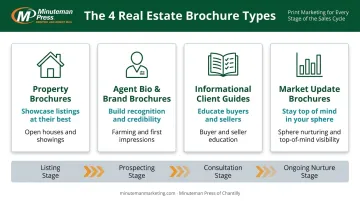
Types of Real Estate Brochures Every Agent Needs
Different brochure formats serve different stages of the sales cycle — and the right one at the right moment can be the difference between a lead that sticks and one that walks.
Property Brochures
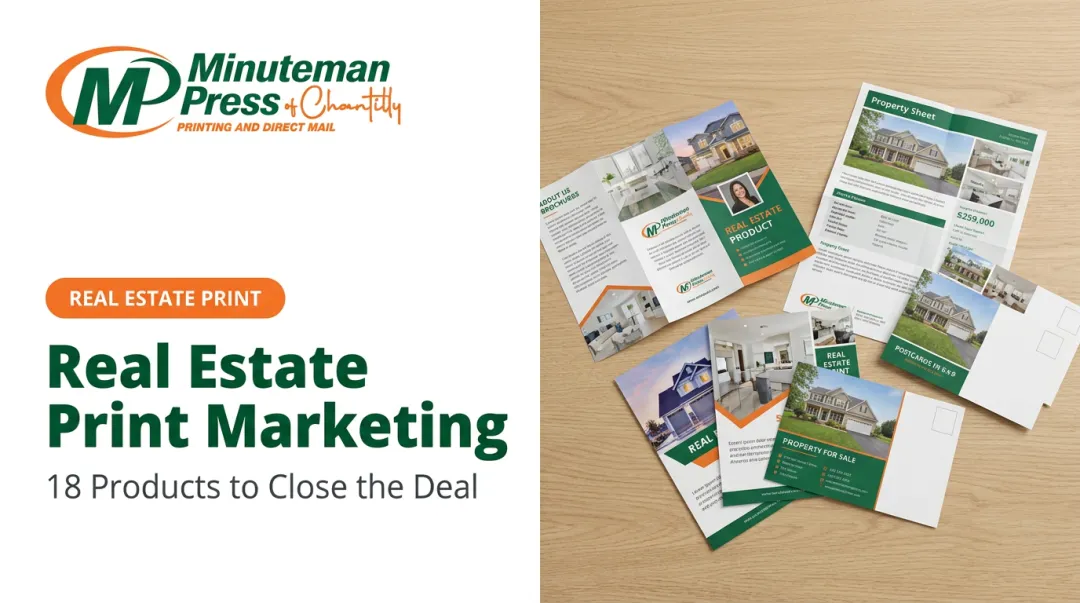
Property brochures are the most common format — and the one most agents think of first. They come in several configurations:
- Single-page flyers — fast to produce, ideal for open house handouts and quick showings
- Bi-fold listing sheets — two panels with room for a strong photo spread plus feature details
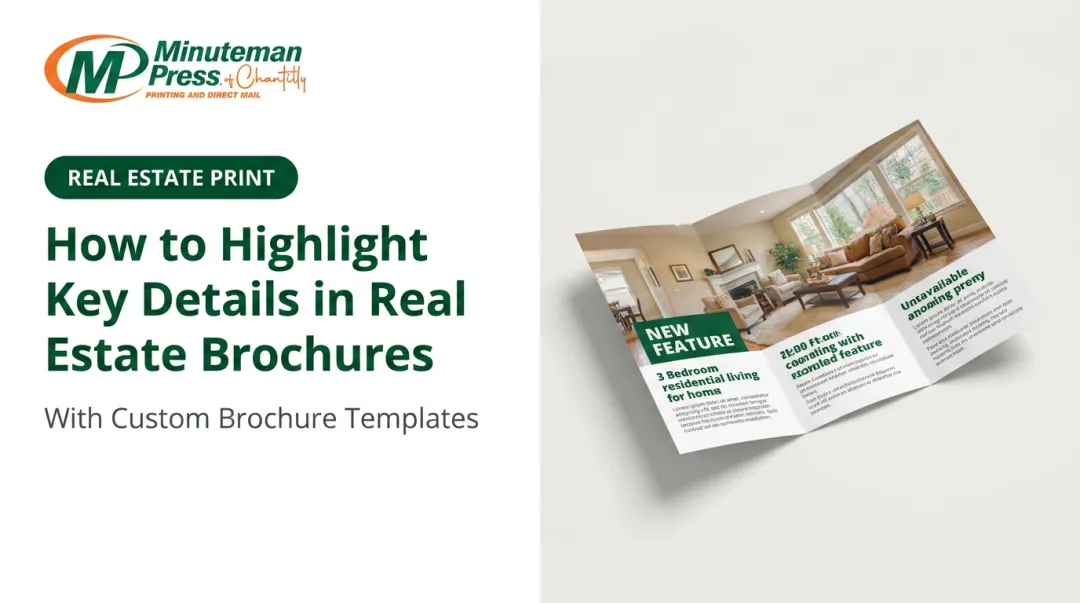
- Trifold or multi-page booklets — best for luxury or complex properties where buyers need more context before committing to a showing
Format choice matters. A single-page flyer works for a straightforward three-bedroom in a familiar neighborhood. A multi-page piece makes sense when the property has distinctive architecture, extensive renovations, or a price point where buyers expect premium presentation.
Agent Bio and Brand Brochures
Agent introduction brochures build name recognition in a farming area before any listing conversation begins. A well-designed agent bio piece typically covers:
- Years of experience and transaction volume
- Neighborhood or market specialties
- Two or three client testimonials
- A headshot and contact block
These are most effective at community events, door-knocking campaigns, and neighborhood sponsorships — anywhere you're making a first impression without a specific property to discuss.
Informational Client Guides
Buyer's guides and seller's guides position you as an expert resource rather than just a transaction facilitator. Walking a first-time buyer through the offer-to-close process, or showing a seller exactly what to expect from prep to settlement, reduces anxiety and builds trust before you're even officially hired.
Targeted guides go further, generating qualified leads from specific audience segments. A few formats worth having ready:
- A rent vs. own comparison for renters sitting on the fence
- A downsizing checklist tailored to empty nesters
- A "why your home didn't sell" sheet for expired listing owners
An expired listing owner who receives a well-designed piece explaining the three most common listing failures is far more receptive than one who gets a generic postcard.
Market Update Brochures
Quarterly or seasonal market updates keep you visible to past clients and your sphere year-round. Including neighborhood-specific data — median sale prices, days on market, active inventory — reinforces your local expertise in a concrete, credible way.
NAR's research on direct mail notes it takes an average of 8.4 contacts within a 30-day timeframe for people to remember a sender's name. A consistent market update series is one of the most reliable ways to hit that threshold with minimal friction.
What to Include in a High-Performing Real Estate Brochure
The best real estate brochures share a consistent structure — and the ones that end up in the trash are almost always missing the same few things.
High-Quality Property Photography
Photos are the first thing a reader's eye goes to, and they set the emotional tone for everything that follows. NAR's 2018 Digital Age report found 87% of buyers who used the internet found photos very useful — and that expectation carries directly into print.
Blurry, poorly lit, or awkwardly composed images will undermine an otherwise strong layout. The cover photo sets the entire tone of the piece, so it should be the strongest image available — typically a well-lit exterior or a hero shot of the most compelling interior space.
Property Details and Features
Every property brochure needs the fundamentals:
- Asking price and price per square foot
- Bedroom and bathroom count
- Total square footage and lot size
- Key amenities (renovated kitchen, primary suite details, outdoor space)
- Architectural style and year built
- School district and neighborhood highlights
85% of buyers found detailed property information very useful, per the same NAR report. A thorough feature list helps buyers make faster, more confident decisions — and reduces the back-and-forth that slows down the process.
Compelling Property Description
A feature list tells buyers what a home has. A good description tells them what it's like to live there. A four-window living room isn't just a feature — it means natural light throughout the day, lower energy costs, and a space that feels open rather than cramped.
Keep descriptions short and specific. Two or three sentences connecting the home's best attributes to the buyer's daily life will do more than a full paragraph of adjectives.
Contact Information and a Clear Call to Action
Contact details — phone, email, website, headshot — must be easy to find. Burying them at the bottom in small print is a common mistake that costs leads.
Pair the contact block with a specific, action-oriented CTA:
- "Schedule Your Private Showing Today"
- "Call for Your Free Home Valuation"
- "Visit [URL] to View All Photos and the Floor Plan"
Generic phrases like "contact us for more information" don't give buyers a reason to act. A specific next step does.
Supporting Elements
Floor plans, a small neighborhood map, and one or two client testimonials round out a complete brochure. NAR found 52% of buyers considered floor plans very useful — for complex or multi-level homes, including one can be a meaningful differentiator.
Real Estate Brochure Design Tips That Convert
Design communicates quality before a word is read. A cluttered, inconsistent layout signals an amateur hand. A clean, well-structured piece signals the same professionalism you're promising to bring to the transaction.
Lead With Visual Hierarchy, Not Visual Clutter
Every page should have one clear focal point — usually the lead photo or the property address and price. White space isn't wasted space; it guides the reader's eye and gives the content room to breathe.
Limit the color palette to two or three brand-consistent colors. More than that creates visual noise that pulls attention away from the property itself.
Use Consistent Branding Across Every Piece
Fonts, colors, logo placement, and tone should be consistent across your brochures, business cards, website, and social profiles. For individual agents, brand recognition is everything in a competitive farm area — and consistency is what builds it.
Stick to one primary font, varied by size and weight (bold, italic) to create hierarchy. Multiple typefaces across a single piece look unpolished.
Choose the Right Fold Format for Your Goal
| Format | Best Use |
|---|---|
| Single-page flyer | Open houses, quick showings, door hangers |
| Trifold | Agent introductions, informational guides, market updates |
| Bi-fold or multi-page booklet | Luxury listings, comprehensive buyer/seller guides |
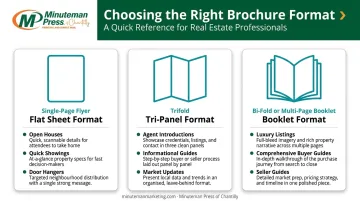
Minuteman Press of Chantilly offers brochures in multiple sheet sizes (8.5x11, 8.5x14, 11x17) with fold options including Half-Fold, Tri-Fold, Z-Fold, Gate-Fold, Accordion-Fold, and Double-Gate-Fold — so the format can match the complexity of your message.
Always Include a Strong, Specific Call to Action
Every brochure needs a clear next step. The CTA should be visually distinct — bold text, a button-style element, or a contrasting color block — and positioned where it won't be missed. This is especially important on informational guides, where it's easy to bury the contact details under pages of useful content.
How to Print and Distribute Your Brochures for Maximum Impact
Even a well-designed brochure loses impact if it's printed on thin, limp stock or handed out without a plan.
Paper Stock, Finish, and Print Quality
Paper weight and finish are the tactile version of your brand. Heavier card stock feels more substantial; a gloss finish makes photography pop; a soft-touch matte finish reads as sophisticated and is less prone to fingerprinting.
Minuteman Press of Chantilly uses offset printing at 300 dpi with RGB-to-CMYK color mapping — so property photography reproduces with accurate color and sharp detail, not the muddy output common with lower-quality digital runs. Available paper options include:
- 80# Gloss Cover — glossy cardstock that enhances photos and bold colors
- 111# Heavy Gloss Cover — durable, vibrant, recommended for real estate marketing pieces
- 130# Silk Cardstock — smooth, soft-touch finish suited to luxury listings where a premium feel matters
Optional UV coating adds both protection and color vibrancy, extending the life of brochures that pass through many hands at open houses.
Distribution Strategies That Get Results
The most effective distribution touchpoints for real estate brochures:
- Open houses and showings — property brochures in hand the moment someone walks in
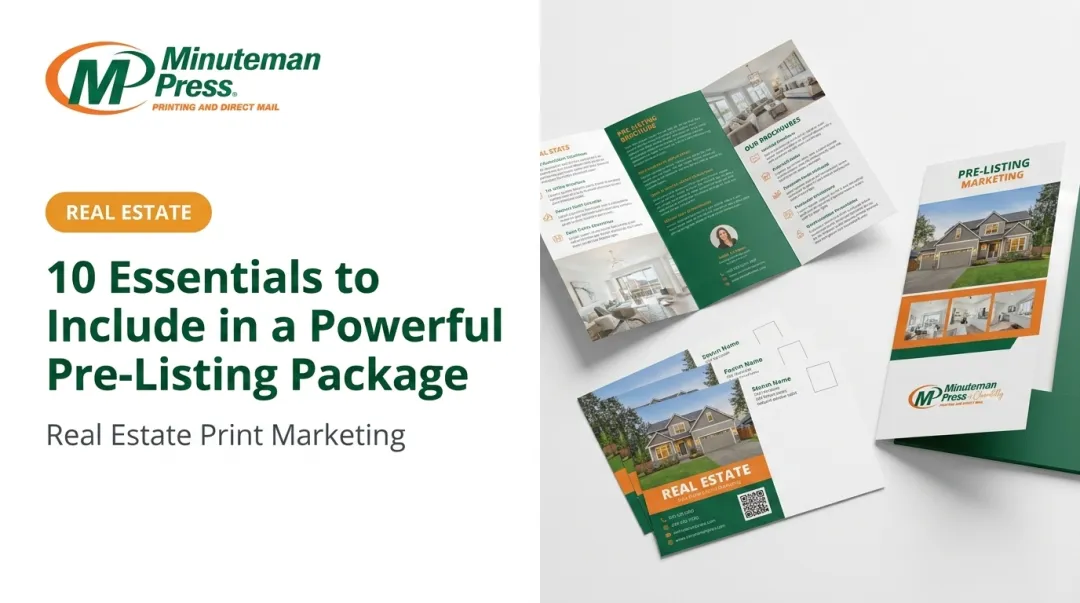
- Listing presentation folders — brochures paired with your CMA and marketing plan
- Direct mail campaigns — neighborhood farming with just-listed/just-sold pieces or market updates
- Local businesses — coffee shops, dry cleaners, and other high-traffic spots near the listing
- Community events and door-knocking — agent bio brochures where you're building name recognition before a transaction exists
For direct mail, USPS's Every Door Direct Mail (EDDM) program allows precise targeting by ZIP code and carrier route, with the option to filter by demographic criteria like age and household size — useful for reaching homeowner-heavy blocks in established Northern Virginia neighborhoods.
Print vs. Digital: Why a Hybrid Approach Works
Print and digital aren't competing — they cover different moments in the buyer journey. Print brochures create a stronger first impression at open houses and for high-value listings where a physical piece signals investment. A PDF version can be shared instantly via email or text for buyers who want to review details after a showing.
Adding a QR code to printed brochures bridges the gap: Bitly's 2025 research found 40% of marketers now place QR codes in print ads, with consumers significantly more likely to engage when a scannable code leads to supplemental content. Link to a virtual tour, additional photos, or a contact form — content that extends the brochure rather than duplicates it.
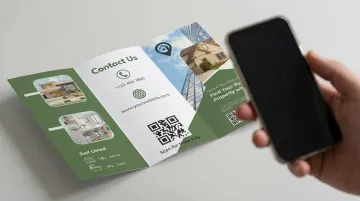
Minuteman Press of Chantilly supports QR code integration across print products, so you can add a scannable code to brochures, listing flyers, and postcards without extra setup.
Frequently Asked Questions
What are the 4 P's of real estate?
The four P's of marketing — Product, Price, Place, and Promotion — apply directly to real estate. The property is the product, pricing strategy drives perceived value, place covers location and distribution channels, and promotion includes all marketing materials. Brochures sit at the center of Promotion and Place, shaping how listings are presented and where they reach buyers.
What should a real estate brochure include?
A complete property brochure should cover the essentials: high-quality photos, a benefit-driven description, and key details like price, square footage, and bedrooms. Round it out with floor plans (when available), neighborhood highlights, agent contact information, and a clear call to action.
What is the best brochure format for real estate?
Single-page flyers work for open houses and quick handouts. Trifolds suit informational guides and agent introductions. Bi-fold or multi-page booklets are best for luxury listings or comprehensive buyer/seller guides that need more room to tell the full story.
Are printed real estate brochures still effective in 2025?
Yes. Physical materials are tangible and memorable in ways digital content rarely is. Buyers and sellers often keep quality print pieces and return to them during the decision process. In a high-value market like Northern Virginia, where transactions average $750,000, premium print presentation is a baseline expectation.
How should I distribute my real estate brochures?
Strong distribution covers multiple touchpoints: open houses, listing folders, EDDM campaigns, door-knocking, community events, and local businesses near your listings. Pair printed materials with a shared PDF to reach both in-person and remote audiences.