Print fulfillment automation applies the same logic agents already use for digital channels — define your triggers, set your templates, and let the system execute. According to the ANA's Response Rate Report, direct mail to house files delivers a 15.6% response rate and 161% ROI — outperforming email and digital display by a wide margin.
This guide covers why print still belongs in your marketing mix, which materials to automate first, and how to build a workflow that connects digital triggers to physical print delivery.
Key Takeaways
- Automated print fulfillment triggers, produces, and ships materials based on preset rules — no manual reordering
- Postcards, flyers, and brochures deliver the most consistent ROI when automated across the buyer and seller journey
- QR codes and unique URLs bridge print and digital, making physical campaigns as measurable as any ad
- Brand consistency across every automated piece builds credibility in your farm area
- Pre-loaded templates and fast turnaround are what make print automation actually work at scale
Why Print Still Belongs in Your Real Estate Marketing Automation Strategy
Real estate is a trust business. Buyers and sellers are making the largest financial decisions of their lives, and they're choosing agents based on perceived credibility. Kantar research found that consumer trust in offline advertising channels averaged 20%, compared to 11% for online channels — a meaningful gap when you're competing for a listing.
A seller in your farm area may see dozens of online ads from competing agents on any given day. A well-designed postcard in their mailbox is tangible and harder to ignore.
Print Amplifies Your Digital Campaigns
Adding physical mail to a digital campaign doesn't just add another channel — it multiplies the effect of everything else you're doing. Canada Post's neuromarketing research found that integrated direct mail and digital campaigns generated 39% more attention than digital alone, with a 10% higher brand recall rate.
For a neighborhood farming strategy, that combination matters. An agent who runs Facebook ads and sends monthly market update postcards to the same zip code is reinforcing their name across two channels. When a homeowner is ready to sell, that agent is the one they remember.
Hyperlocal Targeting Print Does Better Than Digital
Digital ads can target by geography, but they're imprecise at the neighborhood level. USPS Every Door Direct Mail (EDDM) lets agents select specific carrier routes and deliver to every household on that route — no mailing list required. EDDM Retail postage runs as low as $0.247 per piece, making neighborhood saturation campaigns genuinely affordable.
The buyer and seller journey spans several touchpoints, and each one is an opportunity print can own:
- Awareness — a just-listed postcard introduces the agent to the neighborhood
- Consideration — an open house flyer keeps them top of mind during the search
- Relationship — a post-closing thank-you card turns a transaction into a referral source
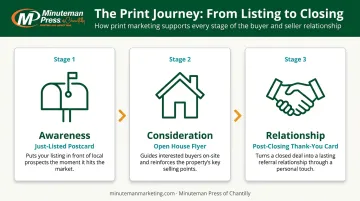
Automating these touchpoints means no stage gets skipped when an agent is deep in another transaction.
Key Print Materials Real Estate Agents Should Automate
Not all print materials carry equal weight in an automated system. These are the ones worth building workflows around:
Postcards
Postcards are the workhorse of automated real estate print. They're affordable per piece, fast to produce, and suitable for recurring campaigns across the entire transaction lifecycle:
- Announce new listings to your farm area with Just Listed mailers
- Demonstrate market activity and build authority with Just Sold cards
- Drive open house foot traffic from neighbors with invitation mailers
- Stay top-of-mind between transactions with market update mailers
- Keep past clients engaged through SOI (Sphere of Influence) touch campaigns
Minuteman Press of Chantilly offers postcards in five sizes: 4×6, 5×7, 6×9, 5.5×8.5, and 6×11. The 4×6 standard and 6×11 jumbo are the most popular for real estate campaigns.
The 6×11 jumbo gives you room for high-quality property photography, interior shots, QR codes, and full agent branding — a format that works particularly well for luxury listings.
Flyers and Brochures
Flyers and brochures serve a different purpose: they're mid-funnel materials handed to buyers who are already interested. At an open house, a well-designed brochure does the selling when the agent is occupied with another visitor.
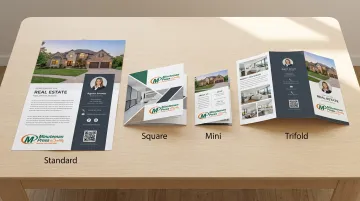
Minuteman Press offers listing brochures in Standard (8.5×11), Square (8.5×8.5), and Mini (8.5×5.5) formats, plus Trifold Listing Brochures that fold into a compact, envelope-ready format — ideal for mailing to neighbors before an open house. Premium formats with 4, 8, 12, or 16-page configurations accommodate luxury properties that need more photography and detail.
Business Cards, Greeting Cards, and Thank-You Mailers
These materials support two different moments in the agent-client relationship:
- Business cards need to be on hand at all times. Minuteman Press of Chantilly offers same-day rush production for orders placed before 1 PM (with a $45 surcharge), so running out at a networking event or after a brokerage change becomes a non-issue.
- Greeting cards support relationship nurturing: post-closing thank-yous, home purchase anniversaries, and holiday touches that drive referrals. Folded formats (10×7 and 8×6) are available in quantities from 100 to 1,000.
The agents who consistently generate referrals are usually the ones who actually send these materials. Having print-ready templates and a reliable production source means those touches happen on schedule, not whenever there's time.
How to Build an Automated Print Fulfillment Workflow
Defining Your Print Triggers
Every automated print workflow starts with identifying the events that should prompt a print order. Common real estate triggers include:
- New listing goes live → Just Listed postcards to the surrounding carrier route
- Open house scheduled → Flyers mailed to neighbors within a defined radius
- Deal marked closed → Thank-you card to buyer or seller
- 90-day anniversary → Past client postcard with market update
- Contact enters "farm list" segment → Monthly market update mailer series begins
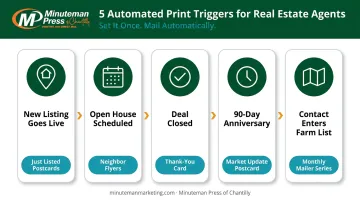
Defining these triggers means materials are already in production by the time an agent would normally think to order them — shifting print from a last-minute task to a background process.
Pre-Loading Branded Templates
Automation breaks down when agents start from scratch on every order. A master brand template with your logo, brand colors, fonts, and contact details locked in gets populated with property-specific information (address, price, photos) for each new campaign.
What a good real estate print template includes:
- One strong headline ("Just Listed in [Neighborhood]")
- One high-resolution property image
- Key specs (beds, baths, square footage, price)
- Agent photo and brokerage branding
- A single clear call-to-action (QR code, phone number, or URL)
Minuteman Press of Chantilly supports customer-uploaded design files (PDF, images) at 300 DPI, as well as their online Designer Studio and pre-designed real estate templates. Agents who already have branded files can upload them directly; those who need design help can work with the in-house design team.
Selecting a Print Fulfillment Partner
The right print partner makes the workflow seamless. The wrong one creates bottlenecks. Key criteria to evaluate:
- Wide product range — postcards, flyers, brochures, business cards, greeting cards from one source
- Fast turnaround — standard 2-3 business days, with same-day rush available for time-sensitive campaigns
- Template library — pre-designed real estate templates that can be customized without full redesigns
- Flexible pickup — Minuteman Press of Chantilly's 24/7 outdoor pickup kiosk with QR code access lets agents retrieve orders any time, free of charge
Connecting Print to Your CRM
Once you've chosen a print partner, the next step is linking print actions to your deal pipeline. Most real estate CRMs don't have native print integrations, but two practical approaches work well:
Trigger-based ordering: Tools like Zapier can connect CRM deal-stage changes to ordering actions. When a deal moves to "Closed," a notification or task fires automatically — prompting the print order without any manual tracking.
Pre-set checklist method: Even without technical integration, a simple deal-stage checklist with pre-saved templates and specs works reliably. Placing a repeat order through Minuteman Press with saved specifications takes under two minutes — far faster than building each campaign from scratch.
Integrating Print Automation With Your Digital Marketing Stack
Print and digital aren't competing channels — they're stronger together. Here's how to connect them:
QR Codes as the Bridge
A postcard with a QR code linking to a virtual tour, listing page, or home valuation tool turns a physical piece into a measurable digital touchpoint. Generate QR codes before production, test them on multiple devices, and confirm they link to a mobile-optimized destination.
USPS EDDM for Neighborhood Saturation
EDDM (Every Door Direct Mail) lets agents select specific carrier routes and reach every household in a target area without a named address list. It's one of the fastest paths to farm-area awareness — particularly effective for Just Listed campaigns where an agent wants to build local presence quickly.
Closing the Attribution Loop
Without tracking mechanisms, print is impossible to evaluate — and often gets cut from budgets unfairly. Direct mail response rates can be measured using built-in tracking tools. Every automated print piece should include at least one of the following:
- QR codes that link to landing pages with UTM parameters
- Dedicated phone numbers tied to specific campaigns
- Personalized URLs (PURLs) that tie a physical mailer to a named recipient's digital journey
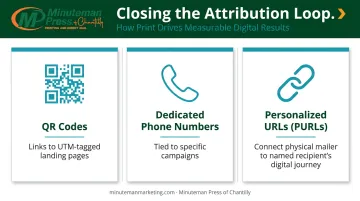
This connects physical campaigns to actual leads and keeps print accountable alongside your digital spend.
Common Mistakes Agents Make With Automated Print Marketing
A few predictable missteps can quietly undermine an otherwise solid print strategy. Here's what to avoid:
- Treating print as an afterthought: One-off orders placed "when you remember it" are slower, cost more per piece, and create gaps in your outreach. An automated, trigger-based system with recurring campaigns keeps your pipeline consistent without the manual effort.
- Inconsistent branding across campaigns: Switching templates, fonts, or color schemes between mailings confuses recipients and erodes brand authority. Lock in a single brand kit — logo, colors, typography — before automating, so every piece looks like it came from the same professional office.
- Skipping tracking mechanisms: Postcards with no QR code, unique URL, or dedicated phone number are impossible to evaluate. Tracked campaigns give you the attribution data to prove ROI and refine future sends based on what's working.
Frequently Asked Questions
What is the best marketing platform for real estate?
The best platform depends on your goals. CRMs like Follow Up Boss or HubSpot handle lead management and digital automation, while a print provider like Minuteman Press of Chantilly handles physical marketing materials. The strongest strategies combine both: digital automation for speed and scale, print for trust and tangibility.
How much does it cost to send out postcards for real estate?
Postage alone runs $0.61 per piece for a standard 4×6 First-Class retail postcard (effective April 26, 2026), while EDDM Retail runs as low as $0.247 per piece. For all-in print-plus-mail pricing, vendor examples like Wise Pelican list 6×9 postcards at around $1.04 per piece — printing, mailing, and postage included — with per-unit cost dropping as order quantities increase.
What print materials should real estate agents automate first?
Start with postcards — Just Listed, Just Sold, and Open House formats have the highest frequency and are the easiest to templatize. Once those workflows are running, expand to open house flyers, listing brochures, and relationship-nurturing mailers like post-closing thank-you cards.
How can I maintain brand consistency across automated print campaigns?
Before building any templates, assemble a brand kit: logo files, hex color codes, fonts, and tagline. Load that kit into your master templates with your print provider so every piece reflects the same professional identity, regardless of how often campaigns run.
Can I integrate print fulfillment automation with my CRM?
Some print platforms offer direct CRM integrations, while others connect via Zapier. Follow Up Boss, for example, documents a workflow where a deal stage change triggers a physical card automatically. At minimum, pre-set templates and specs allow agents to place repeat orders in under two minutes per campaign.
What is the difference between marketing automation and print fulfillment automation?
Marketing automation typically refers to digital workflows — email sequences, social scheduling, lead scoring. Print fulfillment automation refers to systems that automatically produce and ship physical materials based on preset triggers. The most effective real estate marketing strategies use both: digital for speed and reach, print for credibility and physical retention.