Introduction
Digital inboxes during Q4 are a wasteland. Promotional emails stack up unread, paid ads get scrolled past in half a second, and social posts disappear in the feed within hours. Meanwhile, a well-designed postcard lands directly in your customer's hands — and stays there.
That physical advantage matters more during the holiday season than at any other time of year. According to the National Retail Federation, November and December account for roughly 19% of total annual retail sales, with 2025 holiday spending forecast to surpass $1 trillion for the first time. That concentrated window rewards businesses with a physical presence in the mailbox — and postcards are among the most cost-efficient ways to get there.
This guide is for small businesses, freelancers, and retail shops ready to run a real holiday postcard campaign. You'll find what holiday postcard marketing actually involves, why it outperforms other seasonal outreach, which formats to use, and the design and copy principles that drive response rates.
Key Takeaways
- Holiday postcards are a high-visibility, cost-effective direct mail format that captures attention during peak consumer spending seasons
- Campaign success depends on four factors: a targeted list, a compelling offer, a clear call-to-action, and smart timing
- QR codes and personalized URLs connect postcards to digital channels for measurable results
- Plan your campaign at least 6–8 weeks before your target in-mailbox date
What Is Holiday Postcard Marketing?
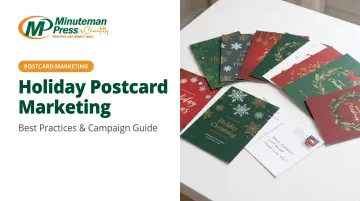
Holiday postcard marketing is the strategic use of printed postcards — mailed or hand-distributed — to reach customers and prospects during the holiday season with promotional offers, seasonal greetings, or event announcements.
In practice, a campaign involves four core components:
- A branded postcard designed for the season and the specific campaign goal
- A segmented mailing list targeting the right audience
- Precise timing based on your intended in-mailbox date and USPS delivery windows
- A specific action for the recipient to take — redeem a code, scan a QR code, visit a location
What separates holiday postcard campaigns from standard direct mail is consumer mindset. During October through January, people are actively shopping, comparing brands, and receptive to offers in ways that don't apply in February or June. That gift-buying mindset makes personalization and seasonal design significantly more powerful during those months.
Why Holiday Postcards Outperform Other Seasonal Outreach
Physical Mail Gets Handled — Every Time
A postcard can't be deleted unread. According to USPS "Mail Moment" research, 98% of consumers bring in mail the day it's delivered, and 77% sort through it immediately. That's a guaranteed impression that no email or display ad can match when inboxes are flooded and digital ads are competing harder than ever.
Compare that to email. Secondary analysis of the 2025 ANA/DMA Response Rate Report puts direct mail response rates at 4.4% versus 0.12% for email — a gap that widens further when you look at house lists specifically, where the ANA's 2023 data shows direct mail hitting 15.6% response rates.
The ROI Case Is Strong
Postcards require no envelope, weigh less than a letter, and print quickly — keeping production costs low. The ANA 2023 Response Rate Report found direct mail delivering strong returns across list types:
Postcards require no envelope, weigh less than a letter, and print quickly — keeping production costs low. The ANA 2023 Response Rate Report found direct mail delivering strong returns across list types:
- 161% ROI for house lists — well above most digital channels
- 34% ROI for prospect lists, which is why list quality matters so much
- Higher engagement per dollar compared to most paid digital formats
Omnichannel Campaigns Amplify Results
Postcards don't have to operate alone. When direct mail is paired with email or digital retargeting, combined response rates reach 27%, according to Lob's research. Their 2026 State of Direct Mail report found 94% of marketing leaders report stronger results when direct mail is integrated with other channels.
The practical application: send the postcard first, then follow up with an email referencing the offer. Recipients who see both touchpoints convert at significantly higher rates than those who see either one alone.
Types of Holiday Postcards and When to Use Each
Not every holiday postcard serves the same purpose. Choosing the right format for your goal is as important as the design itself.
| Postcard Type | Best Use Case | Ideal Send Window |
|---|---|---|
| Promotional (discounts, promo codes, sale alerts) | Black Friday, Cyber Monday, pre-Christmas urgency sends | Late October – late November |
| Seasonal greeting (holiday wishes, customer appreciation) | Loyal customer retention and brand warmth | Mid-November – early December |
| Event or store invitation (open houses, pop-ups) | Holiday events requiring advance RSVP or planning | 2–3 weeks before event date |
| Post-holiday / New Year (January promos, win-back offers) | Re-engaging lapsed customers after holiday noise clears | First two weeks of January |
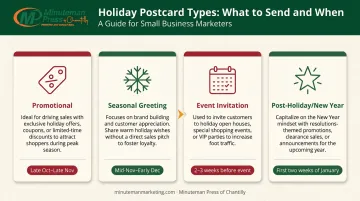
The January send is consistently underused. Once the holiday rush ends, mailboxes empty out and inboxes quiet down — leaving far less competition for attention in the mailbox than any point during November or December.
Matching Format Size to Campaign Goals
- 4x6: Cost-effective for simple greetings, single offers, and high-volume sends — qualifies for standard First-Class postcard postage at $0.61 per piece
- 6x9: Balances design space and postage cost — more room than a 4x6 for supporting details, still mailable at letter rates
- 5.5x8.5 or 6x11: Commands attention in the mailbox, useful for gift guides or multi-offer sends, but carries higher print and postage costs
Minuteman Press of Chantilly prints all five sizes — 4x6, 5x7, 6x9, 5.5x8.5, and 6x11 — across card stocks including Heavy Gloss Cover and Silk Cardstock, making it straightforward to align format and finish with your campaign budget.
How to Plan and Execute Your Holiday Postcard Campaign
Timing is the most underestimated factor in holiday direct mail. USPS delivery slows significantly during peak postal weeks, and print production doesn't pause for tight deadlines. Build every campaign timeline backward — start from the intended in-mailbox date and work back.
Backward planning example (Christmas delivery):
- Target in-mailbox date: December 15
- USPS First-Class delivery (1–5 business days): submit by December 10
- Print production (standard 2–3 business days): approve by December 6
- Design finalization: complete by December 4
- List segmentation and offer development: finalized by November 25
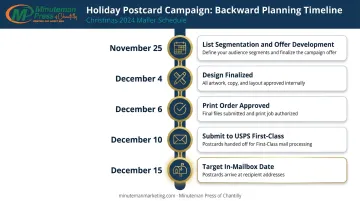
That puts campaign work starting in late November — for a mid-December send. For Black Friday or Thanksgiving campaigns, you're looking at an October start.
Step 1: Set Goals and Segment Your Mailing List
Define a measurable goal before anything else. A specific target shapes every decision that follows:
- 75 in-store visits during the holiday event weekend
- 300 promo code redemptions by December 24
- 120 lapsed customer re-engagements with a win-back offer
Your goal determines your list segmentation. Loyal customers warrant a thank-you and an exclusive offer. Cold prospects need a stronger value proposition. Lapsed customers need a re-engagement hook, not a generic seasonal greeting. A tightly targeted list of 500 qualified recipients will outperform a bloated list of 5,000 untargeted names — the ANA data showing 161% ROI for house lists versus 34% for prospect lists illustrates exactly this gap.
Step 2: Develop Your Offer and Message
Strong holiday postcard offers share three characteristics:
- Urgency: A clear expiration date ("Valid through December 23")
- Clarity: One CTA — not two, not three. One.
- Specificity: "20% off your next visit" beats "special holiday savings"
Proven holiday offer formats include percentage discounts, BOGO deals, free gift with purchase, and early-access sale invitations. Whichever you choose, the offer should appear on the front of the card where it's seen within the first three seconds.
Step 3: Design, Print, and Mail
Once your offer and list are locked, production begins. Key checkpoints:
- Finalize design files with proper bleed (0.125" on all sides) and at 300 dpi
- Choose card stock based on brand positioning — glossy finishes for high-impact promotional sends, silk for premium or luxury feels
- Place your print order at least 2–3 weeks before the intended mail date (add a buffer during October–December when demand peaks)
If you're working against a tight deadline, Minuteman Press of Chantilly has pre-designed holiday postcard templates across seasonal categories — including Holiday & Travel — that let you customize and order without starting a design from scratch. Standard production runs 2–3 business days.
Mailing options at a glance:
| Option | Cost | Delivery | Best For |
|---|---|---|---|
| First-Class Mail | $0.61/piece | 1–5 days | Small sends where timing is critical |
| USPS Marketing Mail | From $0.244/piece (bulk) | 3–10 days | Larger sends with cost as priority |
| EDDM Retail | $0.247/piece | Varies | Geographic saturation, no specific list needed |
EDDM is especially useful for local businesses. It lets you cover a full zip code or carrier route without a mailing list — a straightforward option for retail shops, restaurants, and service businesses reaching nearby households.
Holiday Postcard Design and Copy Best Practices
Visual Hierarchy on the Front
The front of the card has one job: communicate the core offer or emotional hook in under three seconds. That means:
- One bold headline (the offer or seasonal message)
- One striking image
- One focal point — not three competing elements
Supporting details, terms, and secondary messaging belong on the back.
Using Seasonal Design Without Losing Brand Identity
Holiday colors and festive imagery increase emotional resonance — but if a recipient can't identify who sent the card within two seconds, the campaign fails. Brand logo, consistent color palette, and recognizable typography should anchor every design, even when the overall look is wrapped in seasonal imagery.
Personalization Lifts Response
Once your design feels on-brand, personalization determines whether recipients act on it. At minimum, address recipients by first name. More advanced personalization ties offers to purchase history or customer tier — VIP customers might receive a 25% discount while standard customers receive 15%.
The numbers support the investment: according to Lob's 2025 State of Direct Mail, 63% of consumers are more likely to engage with personalized direct mail, and 88% of marketers believe personalization significantly improves response rates.
What a Strong CTA Looks Like
Strong CTAs are specific, easy to act on, and trackable. Compare these examples:
- "Use code HOLIDAY25 at checkout — expires Dec. 24" ✓
- "Scan to shop our holiday sale now" ✓
- "Bring this card in-store for 20% off through December 31" ✓
- "Visit our website" ✗
- "Learn more" ✗
- "Shop now" with no URL or code to track ✗
Every CTA should be specific, easy to act on, and trackable. Unique promo codes, QR codes linked to dedicated landing pages, and personalized URLs (pURLs) all give you measurable data. Without them, you're guessing at ROI.
Print Quality as a Signal
During the holiday season, recipients handle a lot of mail. Heavier card stock and quality finishes make a postcard feel more substantial — which directly affects how long it stays in the house rather than heading to recycling.
Minuteman Press of Chantilly offers card stock options ranging from 100# uncoated cover to 16PT C2S gloss and silk finishes — so you can match the feel of the piece to the impression you want to make.
Common Holiday Postcard Marketing Mistakes to Avoid
Three mistakes consistently undercut holiday postcard campaigns — and all three are avoidable with a little planning upfront.
Starting too late. Ordering print in mid-November for a Thanksgiving delivery is mathematically impossible once you factor in 2–3 days of production and 1–5 days of First-Class mail. Lock in production no later than 6 weeks before your target delivery date.
Mailing to a dirty or untargeted list. Every dollar spent on print and postage is wasted if addresses are outdated or recipients are irrelevant. Before you send, remove duplicates, verify addresses, and segment by customer status.
Treating the postcard as a one-time send. A single mailer rarely converts at its full potential. Pair it with a follow-up email or retargeting ad to reach recipients who noticed but didn't act right away. Research from Lob shows that combined direct mail and email campaigns consistently outperform either channel alone.
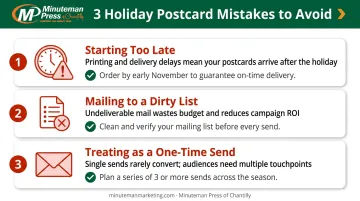
Avoiding these three pitfalls won't guarantee a record-breaking campaign — but ignoring any one of them will limit what your best design and copy can accomplish.
Frequently Asked Questions
What is the 3-3-3 rule for marketing?
The 3-3-3 rule is a direct mail principle suggesting campaigns must reach the right person, with the right message, at the right time. For holiday postcards, this means targeting a relevant list segment with a seasonally appropriate offer during peak buying weeks — not blasting a generic design to the broadest possible audience.
What is the 40-40-20 rule in marketing?
Direct mail pioneer Ed Mayer established that 40% of campaign success comes from the mailing list, 40% from the offer, and 20% from creative design. For holiday postcards, this means who you mail to and what you offer them matters far more than whether the card looks beautiful.
What are the 5 P's of promotion?
The 5 P's — Product, Price, Place, Promotion, People — define the core elements of a marketing strategy. Holiday postcard marketing sits within the Promotion element, using a tangible physical channel to deliver seasonal offers to the right audience at the right price.
When should I send holiday postcards?
Target mid-to-late October for early holiday shoppers, early November for Black Friday and Cyber Monday campaigns, and no later than early December for Christmas delivery. Factor in 2–3 weeks of print production time and slower USPS delivery windows in December when setting your mail date.
What size postcard works best for holiday marketing?
6x9 is the most popular choice — it qualifies for standard direct mail postage while offering significantly more design space than a 4x6. The 4x6 suits budget-conscious sends, while 6x11 and larger formats stand out in the mailbox but carry higher print and postage costs.
How do I track the results of a holiday postcard campaign?
Use unique promo codes, QR codes linked to landing pages, personalized URLs, or dedicated phone numbers to track responses. After the campaign, compare redemption rates and traffic patterns to calculate ROI and refine your approach for next season.