Introduction
Hand someone a flimsy card and watch their expression. There's a brief moment — unconscious, involuntary — where their fingers register the weight, the texture, the finish. That moment shapes how they think about you before they've read your name.
Physical business cards are far from obsolete. A 2025 VistaPrint survey of 800 U.S. working professionals found that 78% still use business cards, with more than half distributing them weekly. The question isn't whether to have a card — it's whether yours is doing any real work.
Premium business cards aren't just a prettier version of the standard option. They affect how quickly contacts follow up, how long they keep the card, and whether they pass it along. The features you choose — stock weight, finish, coating, and print technique — determine which side of that divide your card lands on.
Key Takeaways
- Premium cards use heavier stocks (16pt and above) with specialty finishes that standard printing cannot replicate
- Tactile cues — weight, texture, surface finish — influence how recipients judge professionalism before reading a word
- 76% of professionals credit a memorable business card with opening business doors or boosting revenue — making card quality a direct business asset
- Higher-quality cards stay in circulation longer, lowering the overall cost-per-impression
- The right print partner — with quality materials and design support — ensures the card truly reflects your brand
What Are Premium Business Cards?
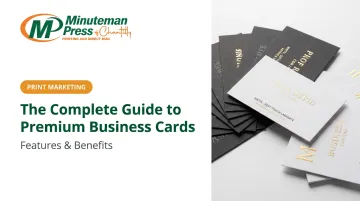
Premium business cards are produced on heavier-grade card stocks — typically 16pt and above — using professional printing techniques and specialty finishes that go beyond standard digital printing on thin stock.
Standard cards start around 14pt (0.014 inches). Premium begins at 16pt, with ultra-thick options reaching 32pt, 48pt, and beyond. At those thicknesses, the card feels substantial in hand, resists bending, and enables deeper finishing effects like embossing and edge painting.
Where They're Used
Premium cards aren't just for executives. They show up wherever first impressions carry real weight:
- Networking events and industry conferences
- Client meetings and sales pitches
- Trade shows where dozens of cards are exchanged in a day
- Real estate showings and property presentations
- Creative industry introductions where the card itself is a portfolio sample
- Any high-value relationship where trust is the deciding factor
A premium card does more than pass along contact details. It signals how seriously you take your brand — before you've said a word.
Key Features That Define a Premium Business Card
Card Stock Weight and Thickness
Card stock weight is the foundation everything else builds on. Heavier stock:
- Resists bending after a day in a wallet or bag
- Supports deeper embossing and debossing without warping
- Creates the immediate tactile signal that something quality is being handed over
The common premium thickness range runs from 16pt to 32pt, with luxury cards reaching 48pt. At Minuteman Press of Chantilly, available stocks include Heavy Gloss Cover (111#), Gloss Cardstock (130#), Silk Cardstock (130#), and the ultra-thick 16PT C2S options — each suited to different finish types and brand aesthetics.
Specialty Materials
Beyond weight, the material itself communicates brand personality:
| Material | Brand Signal |
|---|---|
| Cotton paper | Artisan quality, sustainable, understated luxury |
| Uncoated/textured stock | Refined minimalism, tactile warmth |
| Silk cardstock | Sophisticated, smooth, elevated without high shine |
| Gloss cardstock | Bold, high-impact, vibrant color reproduction |
| Colored core/duplex | Design-forward, high-end, distinctive edge detail |
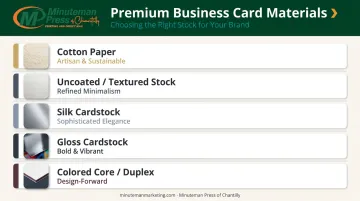
The Silk Cardstock (130# Silk Cover) at Minuteman Press of Chantilly is a practical example: it delivers a soft-touch finish that feels premium without the reflective intensity of full gloss — a strong choice for service professionals who want elegance over flash.
Premium Finishing Techniques
Finishes transform a well-made card into something recipients genuinely remember. The most effective options:
- Embossing — raises selected areas of the paper using a die; ideal for logos and brand marks that benefit from three-dimensional depth
- Debossing — the pressed inverse of embossing, creating an indentation that reads as understated and precise
- Foil stamping — A heated die applies metallic foil (gold, silver, copper, and more) to selected areas; effective on key design elements, not as a background treatment
- Edge painting/gilding — color or metallic applied to card edges; invisible at a glance, striking on close inspection — a detail most people won't notice until they look twice
- Spot UV coating — High-gloss coating applied selectively over matte stock, creating contrast between shiny and flat surfaces
- Letterpress printing — a traditional pressed technique known for its tactile depth and handcraft quality
Minuteman Press of Chantilly offers UV coating options across its card stock range. For specialty finishes beyond UV, their design team can advise on what works best for your chosen stock — since not every finish pairs well with every material.
Design Principles That Support Premium Execution
Even the finest stock and finishes fall flat when the layout fights them. Premium cards work when:
- Layouts use generous whitespace that lets the material breathe
- Color palettes are limited — two or three colors, not six
- Typography is legible at small sizes and suited to the chosen finish
- Negative space is intentional, not accidental
Modern functional additions — QR codes, rounded corners, double-sided printing — belong on premium cards when integrated without disrupting the layout. Minuteman Press of Chantilly's template library includes QR-enabled designs across multiple industry categories, making it easy to add this feature without starting from scratch.
Key Advantages of Premium Business Cards
Stronger First Impressions and Brand Perception
The moment a card changes hands, judgment begins. Research published by the Association for Psychological Science confirms that trait impressions form within 100 milliseconds — and those first judgments are largely driven by sensory input, not information.
A card's weight, texture, and finish register immediately. The feel of a 130# silk card is different from a 14pt standard. That difference communicates durability, attention to detail, and how the individual or business approaches their work.
This matters most where trust is the primary sales driver: real estate, financial services, legal, luxury goods, creative consulting. In those contexts, a premium card is an extension of brand consistency — and 94% of professionals say they want physical and digital business materials to have a consistent appearance.
KPIs affected: Brand perception, first-impression conversion in networking settings, follow-up rate after initial meetings.
Higher Card Retention and Recall
Standard cards have a short shelf life. Most end up in a drawer or the bin within days. A premium card — one with tactile weight, a distinctive surface, or a finish worth examining — becomes a physical object worth keeping.
Consumer haptics research supports the mechanism: studies in the Journal of Consumer Psychology confirm that properties like texture, weight, and hardness influence how people evaluate and remember objects. A card that feels different encodes differently in memory.
The practical implication for cost:
- A standard card discarded in a week delivers one exposure at its full print cost
- A premium card kept for three months delivers dozens of exposures at the same cost
- The cost-per-effective-impression of a premium card is often lower in practice, not higher
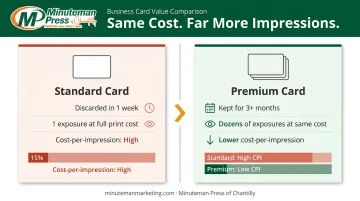
KPIs affected: Card retention rate, brand recall among new contacts, long-term lead generation from networking introductions.
When it matters most: High-volume networking scenarios — trade shows, conferences, industry events — where a recipient sorts through a stack of cards days after collecting them.
Professional Credibility and Networking ROI
According to VistaPrint's 2025 survey, 76% of professionals credited a memorable business card with opening business doors or boosting revenue. The card extends the introduction beyond the moment of exchange — and keeps working long after.
A well-made card also functions as a silent referral. When a contact passes your card to someone else, the quality of that card makes a second impression without you present. A flimsy, generic card undermines the recommendation. A distinctive, well-finished one reinforces it.
As more professionals default to digital-only contact sharing, a physically distinctive card becomes a stronger differentiator — not weaker. It stands out precisely because it's increasingly rare.
KPIs affected: Referral rate, lead conversion from networking, brand awareness among second-degree contacts, customer acquisition cost in relationship-driven sales.
What Happens When You Skip Premium Business Cards
The consequences of using low-quality cards are mostly invisible — which makes them easy to underestimate.
Common operational and reputational costs:
- Thin cards bend and wear quickly. The card a prospect retrieves from their wallet a week later looks nothing like a quality brand
- Generic design on cheap stock is indistinguishable from competitors, eliminating any differentiation from an in-person introduction
- High discard rates mean networking investment generates no long-term return — the time, the print cost, and the conversation all go to waste
- When everything else is polished but the card isn't, that inconsistency registers — and it quietly undermines the impression you worked to make
The price gap between standard and premium cards is often just a few cents per unit. The gap in how a prospect perceives your brand can be far more expensive to close.
How to Get the Most Value from Premium Business Cards
Three decisions determine whether your premium cards deliver on their potential: how you design them, how you order them, and who you print them with.
Design strategy:
- Choose one or two strong finishing techniques — stacking every available effect produces clutter, not quality
- Keep the layout clean enough for finishes to be visible and effective
- Verify that your chosen stock weight supports the finishing method (heavier stock handles embossing better than thinner options)
- Align card typography and colors with existing brand materials for consistency
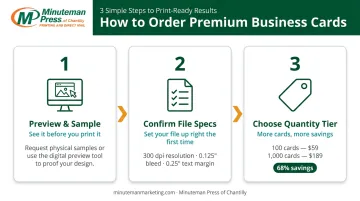
Ordering process:
- Request samples or use digital previews before committing to a full order — Minuteman Press of Chantilly's Designer Studio allows real-time design previews before checkout
- Confirm file specifications meet bleed, resolution, and safety margin requirements (300 dpi, 0.125" bleed, text 0.25" from trim edge)
- Calculate per-card cost across quantity tiers — pricing runs from $59 for 100 cards to $189 for 1,000, with the 1,000-card tier delivering 68% savings per unit
Print partnership: Minuteman Press of Chantilly handles file specs, proofing, and turnaround in one place. Their platform includes:
- Modern offset printing on superior-quality card stocks
- Thousands of pre-loaded templates organized by industry (real estate, legal, healthcare, creative, financial services, and more)
- QR code integration built into standard templates
- Professional design support for layout and finish selection
Their 24/7 pickup kiosk means same-day rush orders — placed before 1 PM — can be retrieved the same day without scheduling around business hours.
Conclusion
Premium business cards aren't a branding indulgence. They're a practical investment in how your brand is perceived — and how long it stays top of mind after the conversation ends.
The decision to upgrade is ultimately about consistency. Every touchpoint a brand controls should reflect the same level of care. A card that holds up in a recipient's wallet for months, gets passed to a second contact, or prompts a follow-up call weeks after a trade show — that's the kind of ROI no digital touchpoint reliably delivers. If you're ready to make that upgrade, Minuteman Press of Chantilly offers customizable premium business card templates you can tailor and order without minimums.
Frequently Asked Questions
What are premium business cards?
Premium business cards are printed on heavier card stocks (typically 16pt and above) using specialty materials and professional finishing techniques such as foil stamping, embossing, or edge painting. They're distinguished from standard cards by their tactile quality, durability, and capacity to create a lasting brand impression.
What finishes make a business card premium?
The most effective premium finishes include embossing (raised impressions), debossing (indented impressions), foil stamping (metallic accents in gold, silver, copper), edge painting or gilding, spot UV coating, and letterpress printing. Combining one tactile finish with one visual finish on thick stock is the most effective approach.
How thick should a premium business card be?
Standard cards run 14pt–16pt. Premium cards typically range from 16pt to 32pt, with ultra-luxury options reaching 48pt. Heavier stock feels more substantial and supports deeper embossing effects without bending or warping.
Are premium business cards worth the extra cost?
For most professionals, the answer is yes. Higher retention rates, stronger first impressions, and greater networking follow-through contribute to measurable ROI — and the cost-per-effective-impression is often lower than standard cards, given how quickly cheap cards get discarded.
What information should go on a premium business card?
Keep it minimal: name, title, company, one primary contact method (phone or email), website or LinkedIn, and optionally a QR code. Less information lets the material and finish take center stage and prevents the card from looking cluttered.
How many premium business cards should I order?
Most professionals benefit from ordering 250–500 cards at a time. Compare per-card cost across quantity tiers before ordering — higher quantities typically lower the unit price significantly, making them worthwhile if you attend regular networking events.