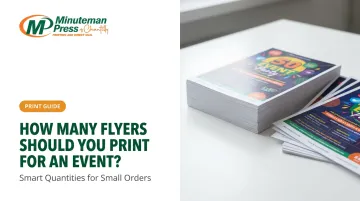
The honest answer is that there's no single right number. The ideal flyer quantity depends on your event size, booth location, staffing, distribution goal, and how long the event runs. Get those variables right, and you can calculate a reliable estimate before you place a single print order.
This guide covers the key factors that affect quantity, recommended ranges by event type, a step-by-step calculation formula, and practical tips to squeeze more value from every flyer you print.
Key Takeaways
- Apply a 10–30% engagement rate to total attendance to estimate realistic flyer recipients
- Break multi-day event totals into per-day distribution estimates, then sum them
- Add a 10–20% contingency buffer to your event total, plus separate counts for pre- and post-event distribution
- Avoid event-specific date references in your design so leftover flyers can be reused
- A well-designed flyer on premium stock needs fewer handouts to make the same impression
Key Factors That Determine How Many Flyers to Print
Attendance vs. Realistic Engagement
Total attendance and actual flyer recipients are not the same number. Most exhibitors can realistically expect 10–30% of attendees to interact with their booth or distribution point.
A trade show drawing 5,000 registered attendees doesn't mean 5,000 people will walk past your table, and even among those who do, not everyone accepts a handout.
Use this 10–30% range as your baseline engagement multiplier. Your position within that range depends on booth location, brand recognition, and how actively your staff engages visitors.
Event Type and Duration
A single-day community fair operates very differently from a three-day industry conference. For multi-day events, don't just apply your engagement rate to the full attendance figure and call it done. Instead:
- Estimate realistic daily interactions based on foot traffic patterns
- Multiply by the number of event days
- Sum the totals
Day-one traffic at most trade shows runs heavier than day three. Factor that in when splitting your per-day estimates.
Your Distribution Goal
What you're trying to accomplish with your flyers should directly shape how many you print:
- Brand awareness campaigns justify wider, less selective distribution — you want volume, so print more
- Lead generation or product launches call for targeted handouts to qualified visitors — fewer flyers, but better conversations
- General event presence falls somewhere in between
Staffing Capacity
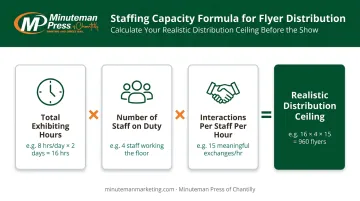
Your staff sets a hard cap on how many flyers can physically be distributed. A two-person booth team working a six-hour show has a realistic ceiling, regardless of how many you print. Use CEIR's Exhibit Interaction Capacity formula as a framework. The calculation is straightforward:
- Total exhibiting hours × number of staff on duty × estimated interactions per staff member per hour
This gives you a realistic distribution ceiling before you ever place a print order.
Bulk Pricing Dynamics
Printing in higher quantities reduces your per-unit cost, but only if you actually use the extras. The price gap between 250 and 500 copies is often smaller than people expect. At Minuteman Press of Chantilly, volume pricing applies across a flexible ordering range (minimum 37 flyers, up to 10,000), and the per-unit savings at higher quantities often justify printing 10–20% above your minimum estimate.
How Many Flyers to Print by Event Type
Small and Mid-Sized Events
Small local events — community fairs, neighborhood festivals, networking nights, grand openings:
- Recommended range: 100–300 flyers
- Foot traffic is lower, interactions are more personal, and geographic reach is limited
- Over-printing is the most common mistake at this scale
- Shelby County, Tennessee's Art for All festival, for example, draws roughly 1,000–2,400 attendees — even at full engagement assumptions, 300 flyers covers most realistic distribution scenarios
Medium-sized events — regional expos, local trade shows, business conferences with a few hundred to 1,000 attendees:
- Recommended range: 300–600 flyers
- Booth location matters here — a spot near the entrance can increase your realistic interactions noticeably versus a quieter back aisle
- Plan toward the higher end if you're near high-traffic flow; scale back if you're in a less central position
Trade Shows and Large-Scale Events
Large trade shows, national conventions, multi-day conferences:
- Recommended range: 750–1,500+ flyers
- Events like PACK EXPO International draw 48,000 attendees across thousands of exhibitors — at 10–15% engagement, a single exhibitor's realistic interaction count is far below total attendance
- Break your total flyer count across days rather than distributing all materials on day one
- Even at large shows, targeted distribution beats indiscriminate handouts
Where your booth sits on the floor shapes how many people you'll realistically reach. EXHIBITOR Magazine notes that traffic flow depends heavily on registration locations, main aisles, and shuttle access.
Dead-end aisles, split-ends, and alcove positions see significantly less natural foot traffic. If your booth is in a lower-traffic zone, adjust your quantity estimate down accordingly.
Pre-Event and Post-Event Distribution
Flyers shouldn't be treated as single-use event materials. Set aside a portion of your print run from the start for:
- Pre-event mailings to prospects, existing contacts, or registered attendees
- Post-event follow-up packages sent to leads collected during the show
Factor these quantities into your total from the start — it extends the value of a single print order without a second trip to the printer.
A Simple Formula to Calculate Your Ideal Flyer Count
Step 1 — Get Official Attendance Figures
Request attendance data directly from the event organizer. Most established events publish verified attendance figures — CES 2024, for instance, reported 138,789 audited attendees. Organizer-provided numbers give you a far more reliable baseline than estimating from scratch.
Step 2 — Apply Your Engagement Multiplier
Multiply the attendance figure by your expected engagement rate:
- 10–15% for large shows with wide distribution across thousands of exhibitors
- 20–25% for mid-sized events with moderate competition for attention
- 25–30% for smaller, more intimate events where booth interactions run higher
Example: 2,000 attendees × 20% = 400 expected interactions
Step 3 — Adjust for Duration and Flyer Versions
Multiply your single-day estimate by the number of event days. Three days at 400 interactions each puts your base total at 1,200.
If you're running multiple flyer versions, split your print run deliberately:
- General brand awareness piece — print the bulk of your order here
- Product-specific sheet — reserve these for qualified conversations; a smaller run is intentional
Step 4 — Add Buffer and Pre/Post Allocations
- Add 10–20% to your event total as a contingency for unexpected foot traffic spikes
- Add pre-event and post-event distribution quantities on top of the buffered total
Example calculation:
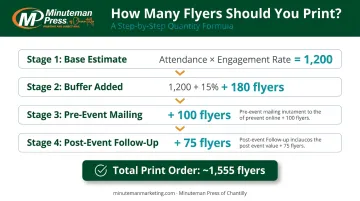
- Base estimate: 1,200 flyers
- 15% buffer: +180 flyers
- Pre-event mailing: +100 flyers
- Post-event follow-up: +75 flyers
- Total print order: ~1,555 flyers
Tips to Avoid Over-Printing and Maximize Every Flyer
Skip event-specific copy on the design itself. Phrases like "See us at [Event Name] this Saturday" lock your flyer to one occasion. Leave those details off and any leftover stock works at your next event, at your location, or in a mailer — no reprint needed.
A QR code linking to a landing page or digital version of your flyer extends reach beyond the handout, enables conversion tracking, and gives recipients a way to act even after they've set it down. Minuteman Press of Chantilly's Designer Studio includes QR code generation as part of the design process, so it's one less step to handle separately.
After each event, note how many flyers you handed out versus how many came back. Over two or three events, that simple tally builds a personal benchmark that outperforms any generic quantity formula.
Why Flyer Quality Affects How Many You Actually Need
A well-designed, professionally printed flyer earns more attention per handout than a cluttered or visually weak one. That means you can achieve the same engagement outcome with fewer flyers distributed, which directly improves your cost efficiency.
What Makes a Flyer Work
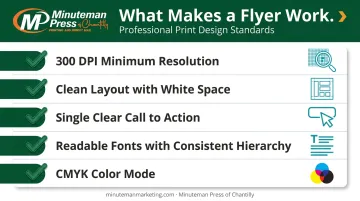
According to print and design authorities including Adobe and AlphaGraphics, professional flyers share these characteristics:
- 300 DPI minimum resolution for all images — anything lower appears blurry or pixelated in print
- Clean layout with adequate white space — crowded design pushes readers away
- A single, clear call to action — one thing you want the reader to do next
- Readable fonts with consistent hierarchy — no more than two type families
- CMYK color mode set before printing — late RGB-to-CMYK conversion causes color shifts
What Makes a Flyer Fail
The characteristics that send flyers straight to the trash:
- Low-resolution or stock-looking imagery
- Overcrowded text with no clear visual hierarchy
- Inconsistent or mismatched fonts
- No clear call to action
- Flimsy paper that feels insubstantial in hand
Paper stock matters more than people expect. A flyer printed on 111# Heavy Gloss Cover or 130# Gloss Cardstock feels substantial and commands attention. The same design on 20# bond paper signals low investment and recipients respond accordingly.
Minuteman Press of Chantilly prints on premium paper stocks using modern offset technology, and their library of thousands of customizable templates makes it practical to produce high-quality flyers without starting from scratch. With no minimum order quantity, you can order exactly what your event requires.
Frequently Asked Questions
How much does it cost to print 250 flyers?
Cost depends on paper stock, size (8.5×11 vs. 5.5×8.5), single or double-sided printing, and finish. Before settling on 250 copies, compare the per-unit cost at 500 — the price difference is often small enough that printing slightly more makes financial sense.
How long does it take to print 1,000 flyers?
Most print shops turn around 1,000 flyers in 1–5 business days. At Minuteman Press of Chantilly, standard production takes 2–3 business days, with same-day rush (+$45) and next-day (+$35) options available. Order at least one to two weeks out to allow for design corrections.
What makes a flyer look unprofessional?
Low-resolution images, cluttered layouts, missing calls to action, inconsistent fonts, and flimsy paper stock are the most common culprits. Any one of these undermines credibility; combine several and most recipients won't bother reading it.
What is a good flyer-to-attendee ratio for events?
A common starting point is one flyer for every 3–4 attendees, adjusted upward for high-traffic booth positions or broad awareness goals, and downward for targeted lead generation. This reflects a realistic 25–30% engagement assumption for most mid-sized events.
Should I print different flyer versions for different audiences at an event?
Two versions — one general and one targeted to a specific product or offer — can improve relevance when used selectively. Print a larger run of the general version for broad distribution and a smaller run of the targeted version to use only in qualified conversations.