Introduction
Every real estate professional faces the same budget decision: pour money into digital ads that reach thousands instantly, or invest in print materials that land physically in a prospect's hands. Get it wrong and you've burned budget on channels that don't convert for your market.
According to NAR's 2025 Profile of Home Buyers and Sellers, 46% of buyers started their home search online — but that means more than half still engage through offline touchpoints like yard signs, open houses, and agent referrals.
Real estate is a high-trust, high-value, hyper-local industry. Both channels play distinct roles at different stages of the buyer journey, and neither dominates outright.
This article breaks down how digital and print marketing compare for real estate — and how to combine them into a strategy that actually converts.
Key Takeaways
- 46% of buyers start online — digital marketing is non-negotiable for reaching active searchers
- Print builds trust and local authority that digital ads struggle to replicate
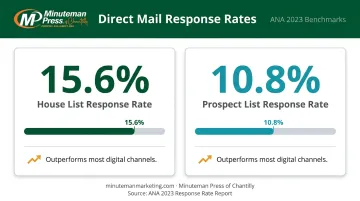
- Direct mail response rates (up to 15.6% for house lists) outperform most digital channels on engagement
- Integrated campaigns consistently outperform single-channel approaches — neither print nor digital wins alone
- Knowing your audience, budget, and property type helps you find the combination that delivers the best returns
Digital vs Print Marketing for Real Estate: Quick Comparison
Here's how the two approaches stack up across the factors that matter most to real estate agents.
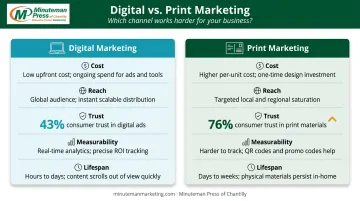
| Factor | Digital Marketing | Print Marketing |
|---|---|---|
| Cost | Variable; low entry point but competitive markets drive up cost-per-click | Upfront production cost; no recurring spend to stay "live" |
| Reach | Broad geographic reach; ideal for out-of-area buyers | Hyper-local; best for specific ZIP codes and farming areas |
| Trust | Lower — social ads earn trust from only 43% of consumers | Higher — 76% of consumers trust direct mail when making purchase decisions |
| Measurability | Real-time dashboards; track clicks, impressions, conversions | Harder to track, but QR codes and custom URLs close the gap |
| Lifespan | Short — disappears when budget stops or algorithm shifts | Long — postcards and brochures stay visible for weeks |
What Digital Marketing Offers Real Estate Professionals
Digital marketing covers every online channel agents use to promote listings and attract clients — search engines, social media, email campaigns, display ads, and listing portals like Zillow and Realtor.com.
Where Agents Actually Generate Digital Leads
According to NAR's 2025 REALTORS Technology Survey, the top lead-generating digital channels for agents are:
- Social media: 39% (Facebook leads at 87% adoption, followed by Instagram at 62%)
- Local MLS/listing exposure: 17%
- Brokerage websites: 13%
- Individual agent websites: 12%
- Digital ad campaigns: 12%
- Email marketing: 11%
Social media dominates, which is why Facebook and Instagram ad spend is a default starting point for most agents.
The Core Benefits
- SEO drives organic visibility on searches like "homes for sale in [city]"
- PPC ads deliver immediate listing exposure for time-sensitive launches
- Retargeting re-engages buyers who viewed a listing but didn't inquire
- Email drip campaigns nurture leads over weeks or months automatically
- Virtual tours let out-of-area buyers qualify properties remotely
Where Digital Falls Short
The same platforms that offer precision targeting also create intense competition. The limitations are real:
- Ad fatigue sets in quickly when every agent in your market runs similar Facebook ads
- Cost-per-lead climbs as click-through rates drop without constant creative refresh
- Visibility stops immediately when your ad budget pauses — there's no residual exposure
- Standing out requires ongoing investment, not a one-time campaign
What Print Marketing Offers Real Estate Professionals
Print marketing covers every physical material agents use to promote listings and build local authority: postcards, flyers, brochures, business cards, yard signs, and direct mail campaigns. For many buyers and sellers, these materials are the first impression an agent makes.
The Trust and Engagement Advantage
This is where print genuinely outperforms digital. A MarketingSherpa consumer study found 76% of consumers trust direct mail/catalog ads when making purchase decisions, compared to just 43% for social media ads. In a transaction as significant as buying or selling a home, that trust gap matters.
Physical materials also create a different kind of engagement. A well-designed postcard sitting on someone's kitchen counter provides repeated brand exposure over days or weeks, something no digital ad achieves once the scroll moves on.
The Hyper-Local Advantage
That trust advantage compounds when print is deployed locally. Real estate is inherently a neighborhood business, and print lets agents "farm" specific areas with consistent, repeated mailings, building authority as the go-to agent in a defined geographic area. Replicating this through digital targeting alone at the block or ZIP-code level is far harder to pull off.
How Modern Print Connects to Digital
Print has closed the measurability gap with a few standard tools:
- QR codes link directly to virtual tours, listing pages, or agent websites
- Custom URLs (for example, yourname.com/mainstreet) track campaign-specific traffic
- Variable Data Printing (VDP) personalizes each mailer with recipient names and property-specific details
For agents who want print materials ready to deploy, Minuteman Press of Chantilly offers customizable real estate postcards, tri-fold listing brochures, and listing flyers through an online ordering platform. Pre-designed real estate templates let agents brand their materials once and reorder without rebuilding the design from scratch each time.
Print's Limitations
- Higher upfront cost than launching a digital ad
- Longer lead times for design, production, and mailing
- Requires intentional tracking mechanisms (QR codes, custom URLs) to measure response
When Print Delivers Real Results
Print excels in specific scenarios:
- Neighborhood farming: Send consistent postcard campaigns to the same ZIP code over months to own a market area
- Just-listed and just-sold mailers: Build social proof and prompt seller inquiries from nearby homeowners
- Open house promotions: Distribute flyers in the surrounding blocks in the days leading up to the event
- Luxury listings: Use premium brochures on 130# silk or 16PT gloss cardstock to match the quality of the property
On the response rate front, ANA's 2023 Response Rate Report puts direct mail house-list response rates at 15.6% and prospect-list response at 10.8%. These are broad marketing benchmarks, but they're strong indicators of print's engagement potential compared to most digital channels.
Which Strategy Actually Wins for Real Estate?
The honest answer: neither channel wins universally. The better question is which combination wins for your specific market, audience, and goals.
Choose Digital Marketing When:
- You need to reach relocating or out-of-area buyers who start their search online
- You're launching a new listing and need immediate, measurable lead generation
- You're targeting younger, tech-savvy buyers who spend more time on Instagram and Google than reading mail
- You have a defined budget and want real-time performance data to optimize against
Choose Print Marketing When:
- You're farming a specific neighborhood and want to become the recognized local expert
- You're targeting demographics less active online — often move-up buyers or sellers aged 50+
- You're marketing luxury or premium properties that benefit from high-quality tangible materials
- You want to create lasting brand impressions that survive beyond an algorithm change
The Integrated Argument
Consider a common scenario: an agent runs digital ads exclusively in a competitive suburban market. Cost-per-lead climbs as more agents bid on the same keywords and audiences. Engagement drops.
Adding a consistent postcard farming campaign to a defined ZIP code creates a parallel channel with distinct advantages:
- No competing in a real-time auction against other agents
- Physical materials stay visible for days or weeks after delivery
- Name recognition compounds with each mailing cycle
The data behind each channel tells a complementary story. Digital dominates as the first touchpoint — most buyers begin their search online. Print earns stronger consumer trust and generates measurable response rates that digital often can't match at the local level. Used together, each channel covers the other's gaps.
How to Build a Winning Real Estate Marketing Strategy
The Multi-Touchpoint Journey
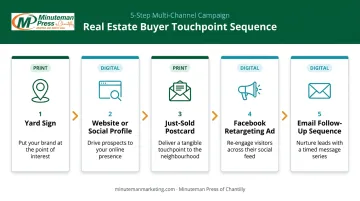
A well-designed integrated strategy creates multiple contact points across the buyer and seller journey:
- A prospect spots your yard sign on a neighborhood listing
- They search your name online and find your website or social profile
- They receive a just-sold postcard from you two weeks later
- A targeted Facebook retargeting ad serves them your newest listing
- They book a consultation after your email follow-up sequence
No single channel closes that loop alone.
Budget Allocation Framework
Tom Ferry's 2026 coaching guidance recommends agents allocate 5–10% of GCI for standard growth markets and 10–15% in competitive or shifting markets. A suggested allocation for most agents:
- Digital advertising (social + search): 35–40% — broad reach, lead capture, retargeting
- Content and SEO: 15–20% — long-term organic visibility
- Local print campaigns: 15–20% — neighborhood farming, listing materials, open house promotion
- Photography and design: 7–10% — quality assets that serve both channels
The split isn't fixed — agents in rural markets with older demographics should weight print more heavily, while agents targeting first-time buyers in urban markets may lean further into digital.
Print Quality as Brand Signal
In real estate, your marketing materials are a direct proxy for how you handle transactions. Thin, low-resolution postcards send a message. So do premium-weight brochures on gloss or silk cardstock with professional photography.
For agents who want professional print materials without redesigning from scratch every campaign, Minuteman Press of Chantilly offers real estate-specific templates you can customize, save, and reorder. Their print lineup covers the core materials agents use most:
- Listing brochures and property flyers
- Just-sold and just-listed postcards
- Open house promotional materials
Same-day pickup is available via their 24/7 outdoor kiosk — a practical option when a last-minute open house or new listing can't wait for shipping.
Frequently Asked Questions
What is the difference between digital marketing and print marketing for real estate?
Digital marketing uses online channels — search, social, email, listing portals — for broad, trackable reach and lead capture. Print marketing uses physical materials like postcards, flyers, and brochures for tangible, trust-building engagement. Both serve distinct roles in a complete real estate strategy.
What type of marketing is best for real estate?
No single channel is universally best. The most effective strategies combine digital (for reach and lead generation) with print (for local authority and trust). The ideal mix depends on your target audience, market competitiveness, property type, and available budget.
Is print marketing still effective for real estate agents?
Yes — particularly for direct mail, neighborhood farming, and open house promotions. ANA benchmarks show direct mail house-list response rates of 15.6%, and consumer trust in direct mail consistently outperforms social media advertising.
What print materials do real estate agents use most?
The core formats are postcards (just-listed, just-sold, SOI), listing brochures, open house flyers, business cards, and yard signs. Each serves a different function — postcards for farming and social proof, brochures for property presentations, flyers for event promotion.
How can real estate agents integrate print and digital marketing?
Add QR codes to postcards and brochures linking to virtual tours or landing pages. Coordinate direct mail campaigns with retargeting ads so prospects encounter consistent messaging across both channels.
What is the ROI of direct mail marketing for real estate?
ANA's 2023 data reports direct mail ROI of 160.9% for house lists, though these are broad marketing benchmarks rather than real-estate-specific figures. Consistent, personalized campaigns targeting warm prospects — past clients, neighbors of recent sales — tend to deliver the strongest returns.