This is one of the most common and quietly expensive problems in local business operations. Print materials get ordered in bulk to hit a reasonable per-unit cost, then become obsolete faster than they get used.
Print-on-demand (POD) is often talked about in the context of online merchandise stores, but its practical value for local businesses shows up somewhere far more immediate: controlling what you spend on everyday marketing materials, and keeping those materials accurate when your business changes.
This article breaks down why POD is a useful operational tool for local businesses—not a trend to follow—and what it actually does for your costs, agility, and campaign effectiveness.
Key Takeaways
- POD lets local businesses order printed materials without committing to large minimum quantities
- It converts bulk print costs into flexible, campaign-specific expenses—protecting cash flow
- Design changes between orders cost nothing extra, keeping materials current as your business evolves
- BrightLocal's 2023 research found 46% of consumers lose trust over an incorrect address—outdated print materials are a real reputation risk
- Businesses that use POD consistently across campaigns build greater savings and flexibility over time
What Is Print-On-Demand for Local Businesses?
Print-on-demand, in the context of local business operations, means one thing: you order printed materials when you need them, in the quantity you actually need—not the quantity that gets you a manageable per-unit price.
That covers the everyday collateral most businesses rely on:
- Business cards, letterheads, and envelopes
- Flyers, brochures, and postcards
- Promotional handouts and event materials
The key difference from traditional printing is that there's no requirement to commit to a large run upfront to justify the order.
For local businesses, POD means accessing professional-quality print materials without bulk commitments or the risk of ending up with boxes of outdated stock every time something about your business changes.
The goal is control: over print spend, brand accuracy, and how quickly you can respond when a promotion ends, prices shift, or a service line gets updated.
Key Advantages of Print-On-Demand for Local Businesses
Each of the advantages below maps to something local business owners actively track: budget, campaign timing, material accuracy, and operational efficiency. They're not theoretical benefits. They show up in real decisions—whether to reorder flyers for a seasonal push or absorb the cost of printing materials that are already obsolete.
Apply POD consistently across campaigns and those advantages compound: lower per-campaign costs, less wasted inventory, and faster turnaround when anything changes.
No Minimum Orders—Print What You Need, When You Need It
Traditional printing economics push businesses toward larger runs. Offset printing involves setup costs—metal plates, color calibration, press preparation—that are fixed regardless of quantity. According to Greenerprinter's 2025 guide on offset vs. digital printing, digital printing is typically less expensive for short runs below 500 to 1,000 pieces, because it avoids those upfront setup costs.
Offset economics push local businesses to over-order, and over-ordering creates waste.
With POD, the threshold disappears. A restaurant can print updated menus for a seasonal special without commissioning a full reprint. A real estate agent can produce property-specific flyers per listing rather than ordering generic materials in bulk. A contractor can reorder 50 business cards after adding a new service line, not 500.
Why this matters for your bottom line:
- Eliminates the financial risk of ordering more than you'll use
- Converts fixed print costs into variable, campaign-specific expenses
- Directly protects cash flow—a critical operational metric for any small business
When this advantage matters most:
- Limited-time promotions and seasonal campaigns
- New product or service launches with uncertain demand
- Any business that updates pricing, hours, or staff information more than once a year
Some POD providers do publish low minimums rather than true zero-minimum policies. Minuteman Press of Chantilly, for example, starts flyers at 37 units and brochures at 26 units. That's far below the hundreds-of-units threshold typical of offset print runs, and it's enough flexibility to make short-run campaign printing genuinely practical.
Cost Control Without Sacrificing Quality
The pay-per-print model changes the financial logic of print marketing. Instead of betting on projected demand—ordering a quantity that might get used over the next quarter—businesses spend only on materials tied to a specific, already-committed campaign.
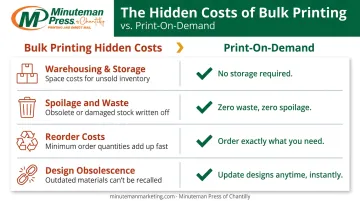
Bulk printing carries several hidden costs that POD eliminates by default:
- Warehousing or storage costs for inventory that's waiting to be used
- Spoilage and waste when materials expire before they're distributed
- Reorder costs when a design change makes existing stock unusable
- Design obsolescence when branding updates render perfectly printed materials off-brand overnight
For businesses operating on tight margins, this matters directly to profitability. Every printed piece that goes unused represents a sunk cost with zero return. POD makes that outcome structurally harder to create.
NFIB's May 2026 Small Business Economic Trends report found that a seasonally adjusted net 36% of small business owners raised average selling prices, with 34% planning further price increases in the following three months. For any local business printing price sheets, menus, service rate cards, or promotional offers, that rate of pricing change means printed materials can become inaccurate very quickly—and reprinting bulk runs to keep up becomes a compounding cost.
KPIs impacted: Cost per campaign, marketing budget utilization, profit margin per campaign, material disposal costs.
Practical note on quality: POD doesn't mean compromising on print quality. Minuteman Press of Chantilly uses modern offset printing technology on a range of paper and cardstock options—from standard uncoated cover to premium silk and gloss cardstock—with optional UV coating. Low minimums don't require trading down on materials.
Design Agility—Update Materials Without Starting Over
Every business change—new pricing, a rebranded logo, updated hours, an expanded service menu—is an opportunity for your print materials to become a liability rather than an asset.
POD removes the penalty for updating. Each order is independent. A local boutique can run spring shopping bags in March and switch to a summer design in June without being locked into a prior inventory purchase. A contractor can reprint business cards when they add a certification without discarding an entire box of the previous version.
The stakes go beyond aesthetics. BrightLocal's 2023 consumer research found that 62% of consumers would avoid using a business after encountering incorrect information, with trust dropping sharply when a phone number or address is wrong.
Printed materials carrying outdated contact details, expired promotions, or an old logo don't just look unprofessional. They actively erode the credibility you've built.
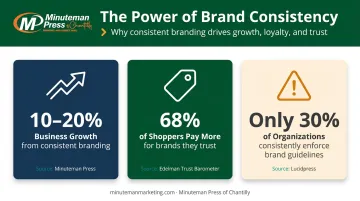
Brand consistency reinforces purchasing behavior:
- Marq's brand consistency research reports that consistent branding can increase business growth by 10% to 20%
- Salsify's 2026 consumer data shows 68% of shoppers will pay more for products from brands they trust
- Only 30% of organizations consistently enforce brand guidelines; POD makes that easier by removing the friction of outdated inventory
When this advantage matters most:
- Businesses going through rebranding, ownership changes, or expansion
- Operations running frequent promotional cycles (monthly specials, seasonal offers)
- Any business where printed information—pricing, contact details, services—changes more than twice a year
What Happens When Local Businesses Skip Print-On-Demand
Most bulk print commitments start with good intentions. A business locks in a run to hit a reasonable per-unit cost. Then something changes—a price increase, a design revision, an expired promotion. The materials in the storage room can't be used, and the cost of reprinting discourages any quick update.
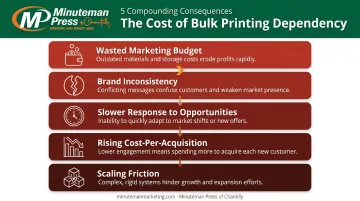
The result is a slow accumulation of compounding problems:
- Wasted marketing budget from printed materials that never reach a customer
- Brand inconsistency when old and new versions of materials circulate simultaneously
- Slower response to opportunities when the reprinting cost makes updating materials feel financially prohibitive
- Rising cost-per-acquisition on print channels as the ROI of each piece declines with outdated messaging
- Scaling friction when expanding to a new location or campaign means navigating an existing stockpile of materials that no longer apply
According to Pitney Bowes collateral management research, 12.6% of print materials become obsolete before they're used. For a business ordering 500 flyers, that's roughly 63 pieces that will never deliver value—budgeted, printed, and discarded.
How to Get the Most Value from Print-On-Demand
POD delivers the strongest results when it's treated as a system, not a one-time solution.
Build print reviews into your campaign planning cycle. Every promotion, seasonal push, or service update should trigger a check: do current materials reflect current messaging? If not, reorder before the campaign launches rather than distributing materials that are already slightly off.
Recommended workflow for local businesses:
- Audit existing inventory before each campaign — pull anything with outdated pricing, contact info, or branding
- Order only what the campaign requires; resist the per-unit pricing pull toward over-ordering
- Update designs between orders rather than reprinting the same version repeatedly
- Budget print spend per campaign, not per quarter, and treat it as a variable cost
For local businesses without an in-house design team, the friction of updating materials can become a barrier, making bulk reorders seem easier than they should be. Minuteman Press of Chantilly addresses this directly: thousands of pre-loaded templates across 15 industry categories, a Signature Studio design tool for self-service customization, and a professional design team available for hire all handle the design burden at the platform level.
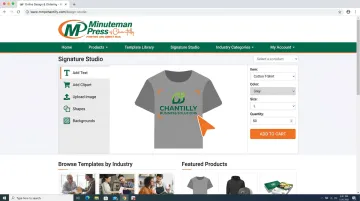
Fulfillment is just as streamlined. Orders ship with quick doorstep delivery, and a 24/7 pickup kiosk means same-day pickup is available for orders placed before 1:00 PM.
Conclusion
Print-on-demand gives local businesses control over one of their most visible operational assets. The advantages aren't abstract—they show up in reduced waste, faster campaign execution, and printed materials that accurately represent your business at every stage of its growth.
Businesses that build POD into their standard operations, rather than defaulting to bulk print orders, build a more agile marketing operation over time. The per-unit cost may be higher at low quantities, but when you factor in the cost of materials that never get used, outdated collateral that damages credibility, and the friction of managing print inventory, the math changes quickly.
Minuteman Press of Chantilly's no-minimum ordering model makes it straightforward to start small, update often, and only pay for what you actually use.
Frequently Asked Questions
What are the pros and cons of print-on-demand?
The main pros are flexibility—no minimum orders, no inventory waste, and the freedom to update designs between runs at no extra cost. The primary cons are that per-unit costs run higher than bulk offset pricing at large volumes, and quality consistency depends on choosing a reliable print partner.
How much does it cost to print brochures or postcards on demand?
Costs vary by size, paper stock, fold type, and quantity. Minuteman Press of Chantilly offers single-unit ordering with no minimums, so you pay only for what you need. Requesting a quote through their online platform gives you exact pricing for your specific product and run size.
What types of print materials can local businesses order on demand?
Common products include brochures, postcards, flyers, business cards, and posters—available across multiple sizes, paper stocks, and fold styles. Minuteman Press of Chantilly offers templates organized by industry, making it straightforward to order materials tailored to your business type.
Is there a minimum order quantity for print-on-demand?
Minuteman Press of Chantilly operates on a no-minimum model, meaning you can order a single unit if that's all you need. This makes POD practical for testing new designs, running small promotions, or keeping print costs proportional to actual demand.
How quickly can local businesses receive print-on-demand orders?
Turnaround typically ranges from same-day to a few business days. Minuteman Press of Chantilly offers same-day pickup via a 24/7 kiosk (orders placed before 1:00 PM), rush next-day production for an additional $35, or standard 2–3 business day production with next-business-day doorstep delivery.
Can local businesses use print-on-demand for seasonal promotions?
Yes—POD is ideal for seasonal campaigns. Businesses can order only what each promotion period requires, update designs between seasons at no extra cost, and avoid carrying leftover stock after a campaign ends.