Introduction
In a competitive real estate market, the difference between a prospect calling and scrolling past often comes down to a single line of text. Most agents know they need a call-to-action — but "Contact us for more information" isn't one. It's filler.
This article delivers 30 proven real estate CTA phrases organized by use case: listings and open houses, lead generation and seller outreach, and consultations. You'll also get the anatomy of a CTA that actually converts, where to place them on print materials, and the most common mistakes that waste your marketing budget.
And while digital gets most of the attention, print materials — postcards, flyers, brochures — remain high-converting touchpoints. According to USPS research, physical mail requires 21% less cognitive effort to process than digital media and generates stronger memory retention. The print advantage only holds, though, when the CTA earns its place on the page.
Key Takeaways
- Strong CTAs use specific action verbs and state a clear benefit — not just an instruction
- Urgency language taps into loss aversion and motivates faster responses
- Buyer, seller, and investor CTAs need different framing to match different motivations
- One dominant CTA per print piece outperforms a list of options
- Tracking tools like QR codes, unique phone numbers, and custom URLs let you measure what's working
What Makes a Real Estate CTA Actually Work
Lead With Action Verbs
Words like "feel free to reach out" or "learn more" give readers permission to do nothing. Strong action verbs — Schedule, Claim, Discover, Call, Book, Unlock — create a pull toward action instead.
Compare these two:
- "Contact us for more information"
- "Call today to find out what your home sold for in 48 hours"
The second one tells the reader exactly what to do and what they'll get. That specificity removes hesitation.
Build In Urgency — When It's Earned
Phrases like "homes like this sell fast," "limited spots available," and "offer ends Friday" tap into loss aversion — the tendency for people to weigh potential losses more heavily than equivalent gains. Prospect theory research confirms that the pain of losing something outweighs the pleasure of gaining it.
Use urgency language only when it's genuine: a property that just received multiple offers, a limited-time free valuation offer, a market report available through end of month. Manufactured urgency backfires quickly in real estate.
Match the CTA to the Audience
Buyers, sellers, and investors have completely different fears and motivations:
- Sellers want to know what their home is worth and whether now is the right time
- First-time buyers want reassurance and access — they need to see properties before someone else does
- Investors want numbers: cap rates, ROI projections, off-market opportunities
A generic CTA loses all three audiences at once. Write for the specific person holding that postcard — and only that person.
Specificity Removes Hesitation
Vague CTAs force prospects to imagine what happens next — and imagination usually fills in friction. Specific CTAs do the work for them.
- ❌ "Call us today"
- ✅ "Call today for a free home valuation — no obligation, results in 24 hours"
The more clearly you describe the outcome, the lower the perceived risk of responding.
Test and Track
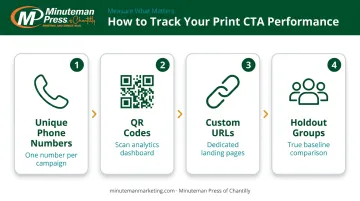
Knowing which specific CTA formulation actually performs requires measurement. Split testing isn't just for digital campaigns — for print, vary one element at a time: the offer framing, the urgency language, or the response mechanism. Tracking tools that make measurement possible include:
- Unique phone numbers per campaign
- QR codes with scan analytics
- Custom URLs and dedicated landing pages
- Holdout groups (recipients who receive no mail, as a true baseline for comparison)
30 Real Estate CTA Phrases That Actually Work
CTAs for Listings and Open Houses
These CTAs belong on just-listed postcards, open house flyers, and new listing brochures. The goal is converting passive interest into a scheduled visit or inquiry — before the property is gone.
10 listing and open house CTAs:
- Schedule your private tour today — this one won't last.
- Call now before someone else claims it.
- Book your showing and be the first inside.
- Join us Saturday 12–3 PM — RSVP today and skip the wait.
- Move-in ready — call to schedule your visit this week.
- New to the market and priced to move — call for details now.
- See it before it's gone — book your showing online in 60 seconds.
- Exclusive preview available — call to reserve your spot.
- Homes in this neighborhood sell in days — schedule your tour today.
- Open house this Sunday — scan to RSVP and get early access.
What makes these work:
- Urgency: "Won't last," "before it's gone," and "sells in days" create a real deadline
- Clear next step: Every phrase names the action — call, book, RSVP, or scan
- Emotional hook: Exclusivity and the fear of missing out push prospects from curious to committed
These elements work together to reduce hesitation right when a prospect is deciding whether to act.
CTAs for Lead Generation and Seller Outreach
These CTAs are the engine of seller lead campaigns. Use them on home valuation postcards, market update mailers, farming campaigns, and expired listing outreach — anywhere the goal is getting homeowners to raise their hand.
10 lead generation and seller outreach CTAs:
- Find out what your home is worth — call for a free report today.
- Curious about your home's value? Get the numbers now — no obligation.
- Selling this year? Schedule your consultation and get ahead of the market.
- Wondering what buyers will pay? Find out today — no guessing, no pressure.
- Unlock your home's value — call for an expert evaluation.
- Your neighbors just sold. Find out what your home could fetch today.
- Market's moving fast — call now to see what your home is worth in this market.
- Ready to make your move? Let's find out what you're working with — free valuation inside.
- Homeowners in [neighborhood] are getting top dollar right now — find out your number.
- Scan to get your free home value estimate — takes 30 seconds.
What makes these work: Seller-focused CTAs must lead with the homeowner's curiosity, not your services. Each phrase offers something free and low-commitment (a valuation, a report, a conversation) while avoiding language that feels like a pitch. That approach builds trust and attracts leads who are genuinely considering their options.
CTAs for Consultations and Relationship Building
These CTAs are ideal for market update mailers, holiday postcards, anniversary cards, and neighborhood farming pieces — any touchpoint where staying top-of-mind matters more than closing immediately.
10 consultation and relationship-building CTAs:
- Thinking about selling? Let's talk — call today and explore your options.
- Start the conversation — call for your free consultation, no commitment needed.
- Questions about the market? I've got answers — reach out anytime.
- Ready to invest? Let's talk strategy and find the right opportunity.
- Let's discuss your options and build a plan that works for your timeline.
- Not sure if now is the right time? Let's look at the numbers together.
- Call for a no-pressure market update — I'll walk you through what's happening in your area.
- Moving next year? Start the conversation now and get ahead of the competition.
- Whether you're ready now or just exploring, I'm here — let's connect.
- Your real estate questions answered — call for a free 15-minute consultation.
Why these convert: Low-pressure CTAs invite rather than demand. Language like "let's talk," "explore your options," and "start the conversation" feels collaborative — the right register for touchpoints where the goal is a conversation, not an immediate commitment.
Where to Place CTAs in Your Real Estate Print Materials
Strong CTA copy only converts when it's visually impossible to miss. Placement matters as much as the words.
Placement Hotspots by Format
| Format | Primary CTA Placement | Secondary CTA |
|---|---|---|
| Postcard (front) | Headline or bold callout box | Back panel with phone/QR |
| Open house flyer | Top third, above the fold | Bottom with address/RSVP details |
| Tri-fold brochure | Back panel (final read) | Inside cover or callout box |
| Listing brochure | Back cover | Inside feature page |
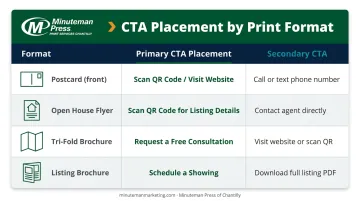
Lob's direct mail CTA guidance is direct on this point: response mechanisms like phone numbers, QR codes, and custom URLs must be given visual weight — not buried in body copy or treated as an afterthought at the bottom of the piece.
The One-CTA Rule
Most postcards should have one dominant CTA. When you list three ways to respond — call, email, text, scan, and visit — you create decision paralysis. One clear action, made as easy as possible to complete, will outperform a menu of options.
Larger formats like tri-fold brochures can support two CTAs, but they need visual hierarchy: one primary (the action you most want), one secondary (a lower-commitment alternative like "scan for more photos").
Print Quality Reinforces CTA Credibility
A compelling CTA on a poorly printed postcard loses its impact before the reader finishes the sentence. The physical quality of the piece signals the quality of your service. Minuteman Press of Chantilly's real estate postcard and brochure templates are printed on heavy gloss cardstock with optional UV coating — so your CTA stands out in a crowded mailbox rather than blending into it.
Common Real Estate CTA Mistakes to Avoid
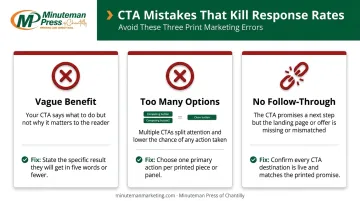
Even a well-designed postcard or brochure falls flat when the CTA itself is broken. Here are the three mistakes that kill response rates:
- Vague benefit: "Contact us for more information" gives prospects zero reason to act. Every CTA must answer: what will I get? A valuation, a showing, a strategy session — name it specifically.
- Too many options: Listing call AND email AND scan AND visit dilutes focus. Pick one primary action and make it frictionless.
- No follow-through: A CTA promising "free insights" or "instant home value" must deliver exactly that. A generic homepage, an unanswered phone, or a vague reply email destroys trust and wastes your print investment. The CTA gets them to act — your follow-through determines whether they convert.
Frequently Asked Questions
What is a call-to-action in real estate marketing?
A real estate CTA is a specific instruction that tells a prospect what to do next : call, schedule, scan, or visit. Without a clear next step, even interested prospects do nothing. A good CTA turns a marketing piece into an actual lead or appointment.
How long should a real estate CTA phrase be?
One to two sentences is ideal. Long enough to include a benefit and a next step, short enough to be read at a glance on a postcard or flyer. If it takes more than five seconds to read, it's too long.
Should I use the same CTA on every print marketing piece?
No. A just-sold postcard CTA should differ from a home valuation mailer CTA because each serves a different stage of the buyer or seller journey. Match the CTA to the goal of the specific piece and the mindset of the person receiving it.
How do I know if my real estate CTA is working?
Use unique phone numbers per campaign, QR code scan analytics, custom URLs, and dedicated landing pages to track responses. Asking new leads "how did you hear about me?" is also a simple, underused method.
What's the difference between a CTA for buyers vs. sellers?
Buyer CTAs focus on access and discovery: tour the home, see the listing, get a neighborhood guide. Seller CTAs focus on valuation and timing: what's my home worth, when should I list. The language needs to match each audience's mindset.
Can I use these CTA phrases on digital marketing materials too?
Yes. These phrases work across email subject lines, social media ads, and website buttons with minor adjustments for platform tone. Consistent messaging across print and digital reinforces recognition and makes prospects more likely to act.