The problem isn't whether direct mail works. It's that managing postcards, mailing lists, design files, and send schedules manually is a significant time drain — one that causes most agents to mail inconsistently, which kills campaign effectiveness. Automation tools purpose-built for farm marketing solve this by handling scheduling, list targeting, design, and delivery from a single platform.
This guide covers the top five direct mail automation tools for farm areas, what makes each one distinct, and how to choose based on your workflow and budget.
Key Takeaways
- Direct mail automation handles design, targeting, scheduling, and delivery so agents maintain consistent campaigns without manual effort
- The best farm tools offer MLS integration, geographic list sourcing, recurring scheduling, and campaign tracking
- Per-piece pricing ranges from under $0.25 for EDDM saturation mail to $1.04+ for all-in mailed postcards with postage included
- Monthly mailing cadence is the expert standard — RPR recommends consistent touchpoints every 3–4 weeks
- Using a generic print vendor with no real estate templates or automated list management undermines the consistency that makes farming work
What Is Real Estate Direct Mail Automation for Farm Areas?
Real Estate Farming, Defined
NAR defines real estate farming as focusing on a specific geographic area where an agent consistently markets to become the go-to local resource. In practice, that means picking a neighborhood — typically somewhere in the range of 300–500 homes based on vendor and coaching guidance — and mailing it repeatedly until your name becomes synonymous with that area.
Direct mail is the backbone of most farming strategies because physical mail lands in front of homeowners directly, without competing with inbox clutter or algorithm-driven feeds.
What "Automation" Actually Means Here
In the context of farm tools, automation covers:
- Set campaigns once and mail goes out monthly without manual intervention
- MLS data integration pulls property photos, listing details, and statuses directly into mailer designs
- Geographic draw tools and data sourcing replace manual list building entirely
- Response tracking connects physical mail to measurable actions via QR codes, landing pages, and engagement alerts
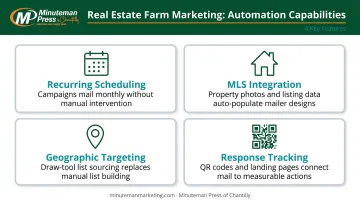
Without these features, agents spend hours per campaign on tasks a good tool handles automatically.
Print Quality Still Matters
A postcard printed on thin stock or with muddy colors undermines the professional brand agents spend years building. Automation depth and print quality aren't either/or — both matter.
For agents who want direct control over their printed pieces, Minuteman Press of Chantilly prints postcards, brochures, flyers, and door hangers on premium cardstock with optional UV coating. Postcard sizes range from 4×6 up to 6×11 jumbo, making them well-suited for supplemental farm materials that run alongside automated campaigns.
Top 5 Real Estate Direct Mail Automation Tools for Farm Areas
Tools below were evaluated across seven criteria:
- Automation depth and ease of setup
- Farm-specific targeting capabilities
- Print quality and template variety
- MLS integration
- Pricing transparency
- Overall ease of use
Wise Pelican
Wise Pelican is purpose-built for real estate direct mail. Its MLS integration covers 95% of listings, allowing agents to auto-populate property photos and details directly into mailer designs — no manual data entry required. There's no minimum order for direct mail, which makes it genuinely accessible for agents testing a new farm.
Verified Pricing (retrieved June 2026): All-in mailed postcards (print + postage + mailing) are priced at $1.04 each. Print-and-ship 6×9 postcards range from $0.86 each at 100 pieces to $0.37 each at 5,000 pieces.
| Feature | Detail |
|---|---|
| Pricing | $1.04/each all-in mailed; $0.37–$0.86 print-and-ship |
| Key Automation | MLS import, recurring campaign scheduling, Mailing List Pro targeting, seller valuation QR tracking |
| Best For | Agents who prioritize design quality and transparent per-piece pricing with no minimum commitment |
PostcardMania
PostcardMania's "Everywhere Real Estate" feature is its main differentiator: once physical mailers go out, recipients are automatically retargeted with digital ads on Google, Meta, YouTube, and Gmail. One send triggers a multi-touchpoint campaign across print and digital — without additional manual setup.
USPS Informed Delivery integration is also available, which the platform claims can increase response rates by an average of 13% (vendor claim, not independently audited).
Verified Pricing: Standard 4.25×6 postcards start at $0.10 each (low volume) and $0.07 each (high volume). Everywhere Real Estate package pricing requires a consultation quote.
| Feature | Detail |
|---|---|
| Pricing | 4.25×6 postcards from $0.07–$0.10/each; campaign packages are quote-based |
| Key Automation | Automated digital retargeting post-send, EDDM support, QR codes, landing pages, USPS Informed Delivery |
| Best For | Agents who want direct mail and paid digital advertising running from a single campaign workflow |
Corefact
Corefact's strength is branded, recurring farm presence. Its Elite program includes a 12-month automated direct mail plan — agents get monthly campaigns running for a full year after setup. The real standout feature is QR-triggered lead alerts: when a recipient scans a Home Estimate QR code, the agent receives an immediate SMS and email notification, enabling real-time follow-up.
Verified Pricing: Calendar postcards from $0.45/print; newsletters from $0.64/print. Elite requires a $499 one-time design fee and a minimum of 500 postcards/month.
| Feature | Detail |
|---|---|
| Pricing | $0.45/print (postcards); Elite setup $499, then standard per-print rates with 500/month minimum |
| Key Automation | 12-month automated farming plan, QR Home Estimate codes with real-time SMS/email lead alerts, recurring scheduling |
| Best For | Agents who want consistent branded farm presence and immediate notification when a homeowner engages |
SmartZip (Smart Targeting)
SmartZip takes a different approach: instead of mailing everyone in a zip code, it scores homeowners by likelihood to sell within the next 6–18 months using 250+ data points (per HousingWire's independent review). Agents mail to the highest-probability sellers first, which reduces wasted spend on low-probability contacts.
Automated postcard campaigns, branded valuation landing pages (SmartHomePrice.com), and homeowner data sourcing are all included. No official public pricing is listed — the site directs users to a demo. HousingWire reports basic plans starting around $500/month, but treat this as a third-party estimate, not confirmed pricing.
| Feature | Detail |
|---|---|
| Pricing | Not publicly listed; contact SmartZip for a quote based on farm size |
| Key Automation | Predictive seller scoring, automated campaigns to top-scored prospects, branded valuation pages |
| Best For | Data-driven agents who want to prioritize farm outreach based on predictive likelihood-to-list scoring |
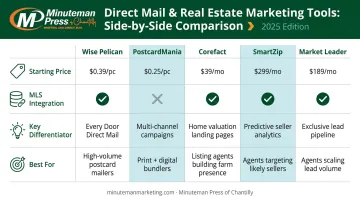
Market Leader
Market Leader is a full CRM platform where direct mail is embedded within a broader multi-channel nurture system. Agents can trigger postcard sends alongside email and phone outreach from a single contact record, with no need to switch between platforms.
Print marketing access includes postcards, flyers, greeting cards, and guides. Shutterfly handles the professional printing. The key distinction from other tools: this is CRM-integrated print nurture, not a standalone farm mailer.
Verified Pricing: Teams plan at $329/month for up to 10 members. Individual Pro pricing requires a consultation.
| Feature | Detail |
|---|---|
| Pricing | Teams from $329/month; Pro pricing is consultative |
| Key Automation | CRM-integrated print campaigns, multi-channel drip sequences, MLS integration, bulk mailing via Shutterfly |
| Best For | Agents or teams who want direct mail embedded in a CRM-driven marketing system rather than a separate tool |
How to Choose the Right Tool
The Evaluation Framework
The tools above were assessed on:
- Automation depth — does the campaign run without manual intervention after setup?
- Farm-specific targeting — geographic draw tools, MLS integration, or predictive scoring?
- Print quality — professional templates, appropriate stock, no generic designs?
- Pricing transparency — can you calculate actual per-piece cost before committing?
- Ease of onboarding — accessible to non-technical agents, not just tech-savvy ones?
Common Selection Mistakes
Agents frequently choose tools based on lowest price per piece without evaluating automation depth. A cheaper tool requiring manual list updates will eventually get skipped when the agent gets busy. A more expensive hands-off tool almost always delivers better ROI. Other common mistakes include:
- Choosing a generic print vendor with no real estate templates or MLS integration
- Overbuilding the farm size before confirming budget for consistent sends
Match Tool to Operating Model
| If you need... | Best fit |
|---|---|
| Transparent per-piece pricing, MLS-powered mailers | Wise Pelican |
| Mail + digital retargeting from one workflow | PostcardMania |
| Automated 12-month branded farming + QR lead alerts | Corefact |
| Predictive seller targeting | SmartZip |
| Direct mail inside a full CRM | Market Leader |
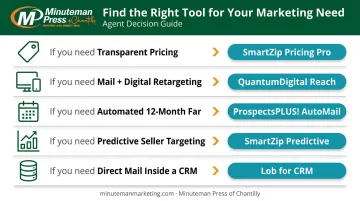
Start with farm size and send frequency, then decide whether print is a standalone channel or one piece of a larger system — that single question narrows the field fast.
Conclusion
No single tool wins across every scenario. Wise Pelican is the cleanest fit for transparent pricing and MLS-powered postcards. PostcardMania extends each mailer with digital retargeting. Corefact automates a full year of branded farming with real-time seller lead alerts. SmartZip adds predictive scoring so you prioritize who gets mailed first — particularly useful in competitive submarkets. Market Leader embeds direct mail inside a complete CRM workflow.
Before committing, assess your farm size, monthly send budget, and how much manual work you're willing to do. A tool that automates 90% of the campaign is only valuable if you'll actually use it month after month.
Automation handles the recurring cadence, but supplemental pieces — flyers, brochures, door hangers, or jumbo postcards — still need a reliable print source. Minuteman Press of Chantilly covers all these formats with customizable real estate templates, no design experience required, and a 24/7 pickup kiosk for Chantilly-area agents who need materials fast.
Frequently Asked Questions
What is the average ROI for direct mail in real estate?
ROI varies by farm size, send frequency, and local market conditions. House list campaigns average around a 5.3% response rate versus 0.6% for email (per DMA/ANA-cited benchmarks), and consistent, targeted campaigns reliably outperform one-off sends across the board.
How many homes should be in a real estate farm area?
Most vendor and coaching guidance (including Tom Ferry) recommends starting with a manageable number you can mail consistently every month — commonly cited as 300–500 homes. A smaller farm executed consistently will outperform a larger one managed sporadically.
How often should I send direct mail to my farm area?
RPR and most farming coaches recommend monthly contact as the standard cadence — quarterly is the floor for maintaining any visibility. Consistent monthly touchpoints build the name recognition that ultimately drives listing calls.
What types of mailers work best for farm campaigns?
Market update postcards, just listed/just sold cards, home valuation offers, and seasonal newsletters consistently perform well because they deliver local value — not just advertising. Rotating formats across months prevents campaign fatigue and gives recipients a reason to keep engaging.
What is EDDM and is it good for farming?
EDDM (Every Door Direct Mail) is a USPS program that delivers to every address on a carrier route without a targeted list. Current USPS postage rates are approximately $0.247 per piece for retail flats. It's cost-effective for broad brand awareness but lacks the personalization and MLS-triggered relevance of list-based campaigns.
What features should I prioritize in a direct mail automation tool?
Focus on MLS integration or status-triggered sends, geographic mailing list sourcing, recurring campaign scheduling, and QR or URL tracking. Tools that automate list management and scheduling eliminate the manual workload that causes most agents to go inconsistent — the most common reason farm campaigns stall.