Postcard mailer response rate measures how many recipients take a desired action — booking an appointment, redeeming an offer, scanning a QR code — after receiving your card. With inboxes overflowing and social feeds increasingly ignored, physical mail is reclaiming attention in a way that matters for hyperlocal service businesses.
Understanding where your campaigns stand against real benchmarks helps you allocate your marketing budget more deliberately and outperform the salon down the street that's still guessing.
Key Takeaways
- Plan for a 2–3% response rate as your baseline — targeted house-list campaigns to existing clients typically run higher
- Personalization, hyperlocal targeting, and offer strength drive response far more than postcard size alone
- 72% of consumers read direct mail the same day it arrives — attention is high, but conversion depends on your offer and call-to-action
- QR codes, unique promo codes, and dedicated URLs are essential for measuring what's actually working
- Combining postcards with digital follow-up consistently outperforms either channel used alone
Postcard Mailer Response Rate Benchmarks for Salons and Spas in 2026
What the Numbers Actually Say
No authoritative public source has published a verified 2025–2026 response rate specifically for salon or spa postcards. Plenty of marketing articles throw around figures without backing them up — so treat any hyper-specific "salon postcard response rate" claim with skepticism.
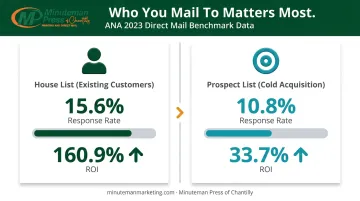
What does exist is broader direct mail benchmark data. The ANA's 2023 Response Rate Report shows aggregate direct mail response rates of 15.6% for house lists (existing customers) and 10.8% for prospect lists (cold acquisition), with ROI of 160.9% and 33.7% respectively. These are all-format, all-industry figures — not postcard-only, not salon-only — but they establish something important: who you mail to matters more than almost anything else.
For local postcard campaigns targeting cold neighborhoods, 2–3% is a practical planning floor. For targeted campaigns to lapsed clients or high-fit households, performance can climb considerably. Use your own campaign data to calibrate over time. Understanding that gap — between passive readership and actual bookings — is what makes or breaks a campaign's ROI.
Read Rate vs. Response Rate
These two metrics are not the same thing, and confusing them leads to unrealistic expectations.
- Read/attention rate: 72% of consumers read direct mail the same day it arrives, and 62% say physical mail has inspired them to take action
- Response rate: The share who actually book, call, or redeem — determined by offer quality, targeting precision, design clarity, and call-to-action strength
A postcard that gets opened but has a vague offer and no booking link will sit on a kitchen counter and do nothing. The attention is there — converting it comes down to your offer and how clearly you ask for action.
Why Response Rate Isn't the Only Metric That Matters
For salons specifically, a 2–3% response rate on a 500-piece mailing means 10–15 new clients. If even half become regulars visiting 6–8 times per year at an average ticket of $60–$80, a single campaign can generate thousands in annual recurring revenue. Tracking both metrics together gives you a complete picture of what a campaign actually earned.
Define "response" clearly before you launch:
- Phone call from the postcard number
- QR code scan leading to your booking page
- In-store redemption of a printed offer code
- Online booking using a campaign-specific promo code
Key Trend 1: Personalization and Hyperlocal Targeting Drive Higher Response Rates
Beyond "Dear [First Name]"
Personalization in 2026 means more than printing someone's name at the top. It means sending a hair color promotion to clients whose service history shows color appointments, or targeting households within your zip code whose demographics match your existing high-value client profile.
Lob's 2025 State of Direct Mail report found that 88% of marketers say personalization significantly improves response rates, and consumers are 63% more likely to engage with personalized mail. Variable data printing makes this cost-effective even at small quantities. Salons can print personalized names, unique promo codes, or service-specific messaging on individual cards without a full design overhaul.
EDDM for New Client Acquisition
When you don't have a customer list, USPS Every Door Direct Mail (EDDM) fills the gap. It lets you blanket every household along a mail carrier route within a defined radius — no list purchase required. Current EDDM Retail postage runs $0.247 per piece, with minimums of 200 pieces and a cap of 5,000 per day per ZIP code.
EDDM works well for:
- Grand openings and new location announcements
- Seasonal promotions targeting an entire neighborhood
- Brand awareness in high-density residential areas near your salon
EDDM can't personalize to individual service history, so treat it as a reach tool rather than a relationship-building one. When you want relevance over volume, first-party client data is where the real response rate gains live.
Win-Back and Birthday Campaigns: The Highest-Relevance Use Cases
When relevance is high, response follows. Two postcard types consistently outperform generic acquisition mail for salons:
- Win-back mailers targeting clients who haven't booked in 90–180 days, with a "we've missed you" offer and a specific expiration date
- Birthday mailers offering a complimentary add-on or discount timed to the client's birth month
Both use first-party data you already have. Both feel personal rather than promotional. They don't require large quantities — a well-targeted list of 200 lapsed clients will likely outperform 2,000 untargeted neighborhood addresses.
Key Trend 2: Postcard Size, Design Quality, and Paper Stock Affect Bookings
Choosing the Right Size for the Right Campaign
Postcard size isn't a cosmetic decision — it affects print costs, USPS classification, and how much creative space you have to make your offer land.
| Size | Best For |
|---|---|
| 4" × 6" | Single-service promotions, new client offers, appointment reminders |
| 5" × 7" | Seasonal packages, mid-tier service bundles, event announcements |
| 6" × 9" | Premium service launches, before/after imagery, gift card campaigns |
| 5.5" × 8.5" | Holiday mailers, multi-service packages |
| 6" × 11" | High-impact acquisition campaigns, grand opening announcements |
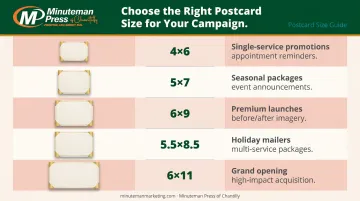
Minuteman Press of Chantilly offers all five sizes with pre-designed Beauty & Spa templates — including designs like Pure Perfection, Zen Retreat Spa, and Spa Serenade — making it practical to test different formats without custom design work.
Design Elements That Convert
Most recipients decide whether to keep or discard a postcard in seconds. These elements consistently improve that conversion:
- One clear offer with an expiration date (urgency matters)
- High-quality photography of your actual services or results
- A single dominant call-to-action — booking URL, QR code, or phone number
- Brand-consistent colors and fonts that signal professionalism at a glance
On the print side, paper stock signals brand quality before the reader consciously registers it. USPS neuromarketing research found that physical mail creates stronger memory and emotional response than digital ads. A soft-touch silk finish or heavy gloss stock reinforces a premium service perception in a way standard copy paper never will.
Minuteman Press of Chantilly offers six paper stock options — from Heavy Gloss Cover and Silk Cardstock to Heavy Silk Cardstock (16PT C2S) — so salons can match print quality to their positioning. A spa charging $180 per facial shouldn't mail on the cheapest stock available.
Worth noting: USPS currently offers a 5% postage discount through its 2026 Tactile, Sensory & Interactive promotion for eligible enhanced-finish mailpieces — running through June 30, 2026. Premium stock can pay for itself.
Key Trend 3: Seasonal Timing and Digital Integration Maximize Campaign Impact
When to Mail
Salons see natural demand spikes that postcard campaigns can amplify:
- Back-to-school (August–September): fresh cuts, color updates
- Holiday party season (October–November): blowouts, updos, skin prep
- Pre-wedding and prom (March–May): bridal packages, group bookings
- Post-winter recovery (February–March): skin, hair repair, waxing
Timing your mailings to arrive 2–3 weeks before peak demand gives clients time to book before your calendar fills.
A practical starting cadence: 4–6 targeted mailings per year, with seasonal campaigns forming the backbone and triggered mailings (win-backs, birthdays) running alongside them. Research from Franklin Madison Direct indicates that more than 80% of consumers find four or more annual direct mail pieces from one brand excessive — so spacing matters. Quality and relevance beat frequency every time.
The Omnichannel Lift
A postcard alone works. A postcard paired with digital follow-up works better. Lob reports that response rates reach 27% when direct mail and email are combined — a meaningful jump from single-channel performance.
Practical integration tactics for salons:
- QR codes that link directly to your online booking page (trackable per campaign)
- Unique promo codes that your salon software can attribute to specific mailings
- USPS Informed Delivery: over 74.8 million consumers are enrolled as of May 2026, receiving email previews of incoming mail — your postcard gets a second impression before it even arrives
- Retargeting ads served to households that received your mailer, reinforcing the message digitally
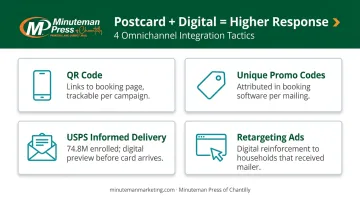
Each of these tactics only pays off if you're measuring results. Yet Lob's 2026 data shows only 22% of companies currently track QR codes to measure direct mail response — meaning most salons have no idea which campaigns are driving bookings. A unique QR code on each mailing batch closes that gap immediately. Minuteman Press of Chantilly supports variable data postcard printing, so each card can carry its own trackable code without requiring a large print run.
What's Driving These Postcard Mailer Trends
Several forces are converging to make physical mail more — not less — effective for salons in 2026.
Digital saturation is real. Consumers scroll past hundreds of ads daily. Kantar's 2024 US Media Reactions report found consumers are increasingly gravitating toward offline advertising experiences they perceive as more natural and trustworthy. A postcard that lands in a physical mailbox doesn't compete with 47 other posts in a feed.
Salons serve a defined geography. Unlike national brands, you don't need to reach a million people — you need to reach the right 500 households within three miles. Physical mail with geographic targeting is built for exactly that use case.
Personalization expectations are rising. Clients expect marketing to feel relevant. Variable data printing now makes it cost-effective to print personalized names, offers, and service references at scale, without requiring a separate print run per recipient.
Three emerging developments are already reshaping how salons approach direct mail — and they're only gaining momentum.
Signals to Watch
- AI-assisted list segmentation: Tools that identify high-lifetime-value prospect households based on behavioral and demographic signals, so acquisition mail reaches households most likely to book
- USPS Informed Delivery expansion: As enrollment crosses 74.8 million, the physical-digital preview touchpoint becomes increasingly valuable — and USPS currently offers a 1% additional discount for campaigns that include an Informed Delivery component
- Augmented reality on postcards: USPS's Irresistible Mail program describes AR as enabling smartphone-activated experiences directly from a printed postcard — still early for most salons, but worth tracking as costs come down
Frequently Asked Questions
What is a good direct mail response rate for salons?
A 2–3% response rate is a reasonable planning floor for local postcard campaigns targeting cold prospects. House-list campaigns targeting existing or lapsed clients often perform 2–3× higher.
How much does it cost to do a postcard mailer?
EDDM postage starts at $0.247 per piece (printing not included). All-in costs for a 6×9 postcard — printing, mailing, and postage combined — run approximately $1.04 per piece at many providers. Design, paper stock, and quantity choices all affect your final per-piece cost.
How often should salons send postcard mailers?
A cadence of 4–6 campaigns per year works well for most salons — aligned with seasonal demand peaks and supplemented by triggered mailings for birthdays and win-backs. Mailing too frequently risks recipient fatigue; less than 3 times per year and you lose top-of-mind presence between appointments.
What should a salon postcard include to maximize response rates?
One compelling offer with a clear expiration date, high-quality service photography, your booking link or QR code, and a single focused call-to-action. Keep the design clean; too many offers on one card consistently dilutes response.
Is direct mail more effective than digital ads for salons?
For local new-client acquisition, postcards often outperform digital ads because they reach a defined geographic area with no algorithm interference. Combining both channels delivers better overall response than either alone — use postcards for reach and tangibility, digital for follow-up and retargeting.
How do you track the success of a salon postcard mailer campaign?
Use a campaign-specific QR code, unique promo code, or dedicated landing page URL — and log redemptions in your booking software. USPS Informed Delivery can also show impression data before the card physically arrives, giving you an early read on reach.