Introduction
Local businesses face a visibility problem that money alone can't solve. National chains dominate digital feeds, run retargeted ads across every device, and have full marketing departments dedicated to staying top-of-mind.
The coffee shop on Main Street, the plumber serving three ZIP codes, or the new gym trying to fill memberships is working with a fraction of that budget — and far less reach.
Digital advertising hasn't made this easier. Google Ads cost-per-lead hit $70.11 in 2025, up over 5% from the year before, and paid social costs continue shifting unpredictably. For small businesses, every dollar matters — and inconsistent results from digital channels make it hard to plan.
EDDM (Every Door Direct Mail) sidesteps those problems entirely. It's a USPS program that lets businesses send postcards to every address on a chosen carrier route — no mailing list needed, no algorithm deciding who sees your message. For small businesses looking to compete locally without burning budget on unpredictable digital channels, that's a meaningful advantage.
Key Takeaways
- EDDM lets you reach every household on chosen USPS routes — no list, no permit needed for retail use
- Postage runs $0.247 per piece, far below First-Class mail rates
- The USPS mapping tool includes free demographic filters: income, age, household size
- Physical mail averages 4.6 interactions per item and stays in the home 7.6 days
- Consistent campaigns compound — local recognition builds with each send
What Is EDDM? A Quick Primer for Small Business Owners
EDDM is a USPS service that delivers postcards, menus, or flyers to every address on one or more selected carrier routes. You pick the routes, meet the piece minimums (200 per ZIP code), and the post office handles delivery — no customer list, no postage meter, no bulk mail permit required for the Retail version.
EDDM comes in two versions:
- EDDM Retail — designed for small businesses, uses a USPS.com account, no special permit needed, up to 5,000 pieces per ZIP code per day
- EDDM BMEU — for high-volume mailers who need a Marketing Mail permit and Business Customer Gateway access
For most small businesses, EDDM Retail is the starting point.
EDDM fits businesses whose customers are geographically defined. Restaurants, home service companies, realtors, gyms, dental offices, retail shops — any brand whose ideal customer lives or works nearby.
The real goal is consistent, recurring visibility in the neighborhoods that generate revenue, so your business becomes the familiar name people reach for when they need what you offer.
Key Advantages of EDDM Postcards for Small Businesses
These advantages are grounded in cost structure, measurable reach, and documented differences in how consumers engage with physical mail versus digital advertising.
Advantage 1: Lower Marketing Costs Without Sacrificing Reach
EDDM Retail postage is $0.247 per piece (USPS Notice 123, effective April 26, 2026). Compare that to:
| Mail Type | Rate |
|---|---|
| EDDM Retail flat | $0.247 |
| First-Class postcard stamp | $0.61 |
| First-Class letter (stamped) | $0.78 |
| First-Class large envelope | $1.63+ |
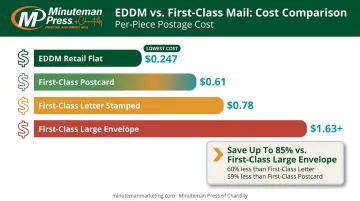
At $0.247 per piece, a business reaching 1,000 households spends $247 in postage. Running that same campaign four times in a year costs less than $1,000 in postage alone. That pricing changes how often a small business can realistically afford to run campaigns.
There's no mailing list to buy. No data vendor to pay. No permit fee for EDDM Retail. Those savings don't disappear — they either reduce the total campaign cost or get reallocated toward better design, larger print runs, or added promotions.
What this means for KPIs:
- Lower cost per impression vs. digital channels
- Reduced cost per new customer acquired
- Higher campaign frequency on the same budget
- More budget available for creative quality
Advantage 2: Hyper-Local Geographic Targeting Without Buying Data
EDDM reaches every address on a route rather than targeting specific individuals. The USPS mapping tool adds real precision: free demographic filtering by median household income, age range, and household size, drawn from U.S. Census data at no cost.
In practice, this means:
- A restaurant filters for routes with household income above $75,000 and household size of 3+
- A gym targets routes within a two-mile radius
- A realtor identifies neighborhoods where listing price ranges match the local income profile
No list broker. No data subscription. No permit fee for EDDM Retail.
The real efficiency gain: instead of casting wide with untargeted advertising to audiences spread across the region, every piece lands within a realistic service radius. A plumber who only services Chantilly and Centreville doesn't need impressions in Leesburg — and EDDM doesn't charge for them.
Businesses can also test routes and compare response rates, then shift spend toward what performs. That iterative approach — run a campaign, track responses by route using promo codes or QR codes, adjust the next send — is a targeting feedback loop that costs nothing extra to use.
KPIs this affects: geographic reach per campaign, response rate by route, foot traffic lift, cost per new customer acquired
Advantage 3: A Physical Format That Holds Attention
A postcard in a mailbox is handled differently than a banner ad. It's a physical object with two sides, a clear offer, and no competing content on the same page. There's no algorithm deciding whether it gets seen, no ad blocker filtering it out, and no feed to scroll past it.
The data on mail engagement reflects this. JICMAIL's Q2 2025 report found that direct mail averages 4.6 interactions per item, stays in the home for 7.6 days, reaches 1.13 people per household, and receives 145 seconds of attention. About 76.5% of mail was read or glanced at.
A Canada Post neuromarketing study found physical mail produced 70% higher brand recall than digital advertising, required 21% less cognitive effort, and was 20% more motivating. A well-designed postcard pinned to a fridge or left on a counter continues generating impressions well after the delivery date.
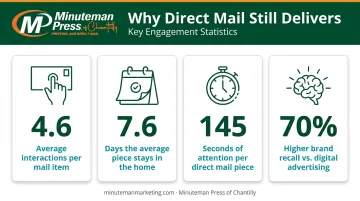
For a small business trying to establish local familiarity, that dwell time matters. Each send reinforces the name, the logo, the offer. After four or five consistent mailings to the same routes, your business starts to feel known — not because of one ad, but because the postcard keeps showing up.
KPIs this affects: brand recall, response rate, repeat customer visits, time-to-action after receipt
What Happens When Small Businesses Skip Consistent Local Outreach
Businesses that rely entirely on digital advertising — or no structured outreach at all — share a pattern: they're invisible to nearby households until someone needs them and happens to search. That's a reactive position. It means competing on Google rankings, racing for ad placements against chains with larger budgets, and hoping organic foot traffic is enough.
The compounding cost of inaction shows up in a few ways:
- Rising acquisition costs: Google Ads averaged $70.11 per lead in 2025, with digital costs increasing across most industries year over year
- No local presence: Without regular touchpoints, nearby households don't know you exist until they're already searching — and often find a competitor first
- Missed compounding value: Businesses that depend on paid digital exclusively pay more each cycle for the same number of leads
One-off EDDM campaigns also underperform relative to their potential. Sending once and stopping leaves most of the value on the table. The recognition advantage compounds when the same households see your postcard repeatedly — a single mailing can generate responses, but a consistent quarterly cadence builds the kind of local brand awareness that drives word-of-mouth and repeat visits.
Losing local market share rarely comes down to one campaign. It's the result of months of inconsistent — or absent — outreach while competitors show up in the same mailboxes every quarter.
How to Get the Most Out of Your EDDM Campaign
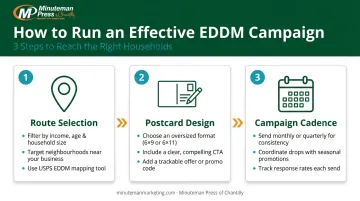
EDDM works best when three things align: the right routes, the right design, and a consistent send schedule. Missing any of the three limits the return.
Route selection:
- Use the USPS EDDM mapping tool to filter by household income, age range, and household size
- Prioritize routes within your actual service radius
- Start with 2-3 routes, track responses, then expand based on performance
Postcard design:
- Use an oversized format (6x9, 6x11, or 5.5x8.5) — these meet EDDM flat requirements and command more attention
- Include one clear, compelling offer — a limited-time discount, a QR code, or a trackable promo code
- Make the call-to-action visible within three seconds of picking up the card
Campaign cadence:
- Plan your follow-up mailing before the first one lands
- Monthly or quarterly sends to the same routes outperform one-off campaigns
- Coordinate sends with in-store events, seasonal promotions, or social media timing to reinforce the message across multiple touchpoints
Once your strategy is set, execution comes down to having print-ready postcards that meet USPS size requirements. Minuteman Press of Chantilly offers pre-designed templates across dozens of industry verticals — restaurants, realtors, home services, fitness studios, pet care, and more — along with custom design services for businesses starting from scratch. Postcards are printed in EDDM-compliant sizes (6x9, 6x11, and 5.5x8.5) on quality card stock, and orders ship directly to your door so you can submit them to your local post office on your own timeline.
Conclusion
EDDM postcards stack three advantages that compound over time: low campaign costs that make monthly mailings practical, hyper-local targeting that puts your message in front of the right neighborhoods, and a physical format that stays on countertops and refrigerators — not a browser tab that closes in seconds.
None of these advantages are one-time. They build with repetition. The fifth postcard a household receives from the same local business carries more weight than the first — because recognition has been earned. Familiarity is built through consistency, and EDDM gives small businesses an affordable way to stay consistent.
Run it month after month to the same routes, and your business stops being a name people vaguely recognize — it becomes the one they reach for first.
Frequently Asked Questions
How much do EDDM postcards cost?
USPS EDDM Retail postage is $0.247 per piece as of April 2026. Total campaign cost also includes printing, but even combined, EDDM is significantly cheaper per impression than most traditional advertising or paid digital options.
What are the benefits of EDDM postcards?
No mailing list required, discounted postage rates, free demographic filtering by income and household size, and a physical format that averages 4.6 interactions per item and 7.6 days in the home. Stronger recall than digital ads with no algorithm controlling delivery.
What is the success rate of EDDM?
There's no single EDDM-specific benchmark, but direct mail broadly sees response rates of around 7% compared to roughly 3% for digital campaigns in comparable studies. Actual results vary based on design quality, offer strength, and how consistently campaigns run.
Do I need a mailing list to use EDDM?
No. EDDM Retail requires no mailing list — the USPS delivers to every address on your selected carrier routes. That's what makes it accessible for small businesses that don't have existing customer data.
What types of small businesses benefit most from EDDM?
Businesses with geographically local customers benefit most — restaurants, home service companies, realtors, gyms, and dental offices are common examples. It's especially effective when launching in a new area or running seasonal promotions.
How often should a small business send EDDM postcards?
Monthly or quarterly sends to the same routes consistently outperform one-off mailings. Repeated exposure to the same households builds brand familiarity over time, which is what converts passive recognition into actual visits and purchases.